Showing posts with label Family History. Show all posts

Friday, July 22, 2022

John Francis Brosnahan's Final Resting Place


Oise-Aisne American Cemetery; Block A, Row 39, Grave 6


Forty-some years ago while wandering through the Catholic cemetery in Brattleboro Vermont (my Irish ancestors are buried there),  I spotted a memorial plaque to a man named John Francis Brosnahan. Several marriages in my ancestral family are with Brosnahans, yet I had not heard of John Francis. The plaque reads:

BROSNAHAN 
In Loving Memory Of
Priv. John F. Brosnahan
Co. L   306 Inf 
Who Gave His Life in France
For His Country
Buried in Fismes, France

The family gravestone adjacent to the above adds more information: 

Sept. 9, 1887 
John Francis
Aug. 19, 1918

I dug right in to find more about John. He was born down the road from Brattleboro on a farm in Vernon, Vermont to Irish immigrants, Patrick Brosnahan and Catherine Brosnahan (yes, that's her birth name). Old issues of the Vermont Phoenix newspaper mention details about John's earlier life. He had an excellent school attendance record. He played football at Brattleboro High School and held down a job at Fenton's men's furnishing store. After graduation he took bookkeeping courses at Albany Business College and then found employment with Hall, Hartwell & Co. in Troy NY. According to the Phoenix, he made regular visits home to see his parents and siblings in Brattleboro. By 1911 he was living and working in New York City at Hanover Exchange Bank, and then at B. Altman & Co. department store. He remained single all his life.

Brosnahan received his draft notice in August 1917 and went into training at Camp Upton on Long Island on October 10. His rank was Private First Class in Company I, 306th Infantry, 77th Division. On April 16, 1918 he sailed for France with his company on the steamer Kashmir. 

By August that year American troops were facing German troops along their defensive lines at the Vesle River near Fismes, France. Full-scale battle was fought from August 3rd to September 1st with terrible loss of life. German howitzers were dropping shells among the American lines, hidden German machine gun nests poured fire onto advancing troops, and flame throwers were so effective that the town of Fismes was destroyed.  

On August 19th, 30-year-old Private Brosnahan was killed by shell-fire. His commanding officer, Captain Earl Marshall, mentioned in a letter to Brosnahan's mother that he was "apparently killed instantly by the explosion of a shell." My first thought was this simple explanation was to spare widowed Catherine any thought that her son suffered, yet the documents relating to his death use the word "none" in the space where wounds would be documented, indicating he probably didn't know what hit him.

John's last letter home, written August 3, carried the remark, "The soldier's life is a great life." We know that combat was fierce on French soil in the summer and fall of 1918. Trench warfare and constant shelling and sniper fire made a soldier's life horrible, but which man was going to confess fear and misery to his distressed mother at home?

Deceased soldiers were first buried in temporary ground near battle sites, and then moved to other accommodations as conditions allowed. Brosnahan's remains were moved several times until the establishment of Oise-Aisne American Cemetery near Fismes in the early 1920s. At this time families of the fallen were given the option to have their soldier brought home for US burial, or to be buried among comrades near where they fell. In this cemetery just over 6000 Americans were laid to rest, and though the specific reason for the Brosnahan family to make this choice is unknown, it was a common one. Tens of thousands of Americans are buried in France.

On our visit to Oise-Aisne we identified ourselves as family of an interred soldier. The superintendent -Bert- pulled out all the stops. He gave us copies of documents pertaining to Brosnahan's military service. Bert handed us American and French flags to plant on the grave, and carried a small bucket of damp sand from Omaha Beach as he accompanied us out to the grave site. He showed us how to rub the sand across the stone's inscription to make it more visible in photos, and we planted the flags in front of the grave, as seen in the photo below. I'm positive we are the first family members ever to visit Brosnahan's grave. Of all the things we did and saw on our European visit this summer. honoring a fallen soldier was the most moving and satisfying.

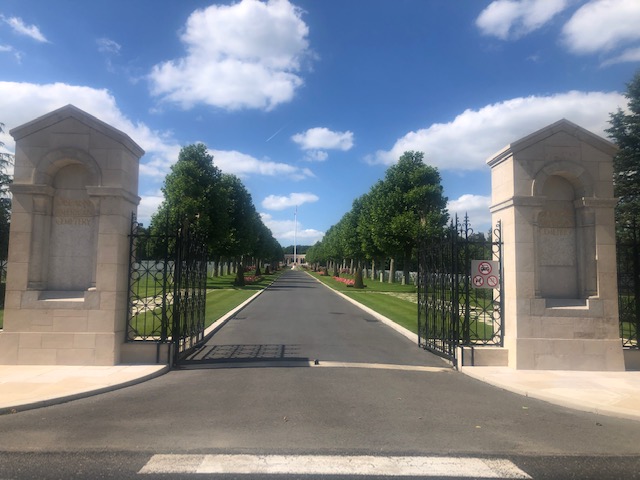


entrance to Oise-Aisne cemetery


a portion of the 6000 burials in the cemetery


map showing the various American divisions' participation in the battle; John Brosnahan was in the 77th Division


NOTE: for more about John Brosnahan click here

Thursday, March 17, 2022

Drum Roll Please . . . the 1950 Census Release is Just Around the Corner


The count-down has begun—only two more weeks until the release of the 1950 Census! What will you find about your family on this census? You may find yourself looking for grandparents, parents, or maybe even yourselves. Perhaps you have wondered where an ancestor was living in that year, or what their occupation was. Have you ever wondered how much money your family earned back in the day? Well guess what—the 1950 Census will tell you. It will selectively tell you who was a veteran, and how many years of education some people had received. All of these details will add new dimensions to your family members and ancestors.

I am curious about where my Dad was living in 1950. He was a World War 2 Navy veteran attending Carnegie  Mellon University on the GI Bill. He may have lived near campus, or perhaps he commuted from his parent’s home south of Pittsburgh. I am wondering what my maternal Grandfather did for a living in 1950. He had changed jobs regularly in earlier years, yet somehow managed to cover the rent. My other Grandfather was a coal miner, and the 1950 Census was taken exactly one year before he was critically injured in a mining accident. 

Contrary to prevailing belief, it was common for women to do paid work back in the day. My Grandmother had worked for S.S. Kresge as a young mother. Whether she still had a job in 1950 is another gem remaining to be uncovered in the upcoming census release. My Mother also was working in the early 1950s, and the census will tell me what type of work it was.

A census record is like a photograph. We may not see what people physically looked like, but we can “see” what their lives were like through the information given. Besides personal details, a census record places our family in the context of a neighborhood, a work environment, and the greater community. Answers to many of our family questions will soon be available to us on our computer screens in the comfort of our homes!

To find out more AND to volunteer to index the 1950 Census, click on the link below: 


Tuesday, November 20, 2018

DNA Inheritance, Simplified

https://creativemarket.com/schwegel/680255-Double-Helix-DNA-Strand

I recently gave a presentation on DNA testing to a community group. We discussed the types of DNA testing available (MtDNA, Y-DNA, Autosomal DNA) and then using the illustration below, I clarified for the group how DNA is passed down through generations.

There is a general misunderstanding that when siblings are children of the same parents, the sibling's DNA will be identical. When it is not (which is always, except for identical twins), some are convinced there has been a testing error. Another incorrect assumption is that because one has traced their ancestry on paper (through research) to particular places, and the DNA results don't match it exactly, the "science" must be bunk. In other words, "the company makes up DNA results just to collect my $99!!" Holy cow, social media teems with posts blasting the accuracy of DNA tests for the above reasons. But DNA is science, and science is real.

Let's look at the chart below which is from the Ancestry website. It's an ingenious way to explain how DNA passes down. First fact to know is that each child receives 50% of their DNA from their father, and 50% from their mother. Second fact: the parts of each parents' DNA that pass to their children are utterly random. You can see below that Edward received half of his DNA from each parent, represented by alphabet letters. Certain characteristics and features of each parent are contained in the DNA he has received. Other parts of one or the other parents' DNA did not pass to him. Same with Edward's wife, Angela.


Angela and Edward's children receive half of each of their parents' DNA, but as you can see, each child does not receive the same pieces. The children might resemble each other or share similar characteristics, and they will also have major differences. If the letter "N" represents perfect pitch, Glenda and Reagan will be musically gifted, while Gerald will struggle to carry a tune. Of course, this is a simplification.

Because Generation A's DNA is halved for their children--Generation B--and Generation B's DNA is halved for their children--Generation C, and so on, one could be only four or five generations removed from an ancestor and not receive any of their DNA. Some have become upset because their test doesn't show the Native American or some other ethnicity that they have been told about their entire lives. Even if you truly descend from Native Americans, it is reasonable that you might not have scientific evidence of it.

Some who have already researched their family back to say, France, are puzzled or distressed that they have only a small percentage of DNA from that area. They are convinced the test can't be correct. It's important to understand that because someone lives in a geographical area, it does not mean that their ethnicity is rooted in that place, and is the same as a neighbor's. Contrary to popular social myth, people did move around a lot in the past. If an ancestor lived in Paris, that does not make them ethnic French.

Though we understand nationality pretty well, it is not the defining characteristic of a person. Do we understand ethnicity? Ethnicity is what is in our blood, and what a DNA test reflects.

Rather than being bound by political borders (nationality), ethnicity is defined by language, culture, ancestry and even religion. My grandparents' nationality was Austro-Hungarian, later called Czechoslovakian after the establishment of that country. But their ethnicity was Carpatho-Rusyn, closely related to Ukrainian. Their native language was not Czech, Slovak, German or Hungarian, but Carpatho-Rusyn. Their ancestors had migrated southwest from Kiev, and their religion was Byzantine Catholic rather than Roman Catholic, as were their Slovak and Hungarian neighbors.

As time marches on, DNA testing for personal discovery purposes will become further refined. Perhaps eventually it will hone in on the time periods a person's DNA is found in a particular place, and become even more geographically exact. I would love to see more migration patterns delineated. The science is advancing rapidly. This knowledge could actually be displayed in the not distant future.


Monday, November 19, 2018

Ancestry DNA Tests 2018

we're all connected in some way or other!
[http://sbims.com/membership-engagement-human-connection/]

Ancestry.com recently updated their user's DNA profiles, not because an individual's DNA changes, but because the science has refined to the point where a simple spit test can closely pinpoint your ethnic origin as contained in your DNA.

When I first took the test nearly two years ago, Ancestry had outlined about 25 or 30 regions in the world, uniquely identified by DNA commonality. These regions were divided not by political boundaries, natural features or continents, but according to the uniformity and uniqueness of DNA found in residents of those regions. DNA samples from living people who have a long ethnic history in a region are the standard comparison, and to make it simple here, as your DNA closely resembles the deep-rooted samples from one of those regions, Ancestry can quantify what percentage of your ancestry comes from that area.

Currently Ancestry's regions have expanded to now number 350, thus their customer's DNA can be honed to a small area. Their sample populations have increased by a factor of at least three, further refining the matching process.

Here is my updated 2018 Ancestry DNA map showing my ethnicity. Look at Ireland, where 50% of my DNA originates. Notice the small circle drawn around the very most southwest part of the country. This is exactly where almost every one of my Irish ancestors come from. Now look at the leaf-green oval drawn around the point where Poland-Ukraine-Slovakia-Romania come together. 45% of my DNA originates from there. Both of these regions I long-ago identified as domiciles of my ancestors, and now DNA testing has corroborated that. Amazing!


NOTE: my only DNA surprise involves 5% of my DNA: 4% of that is Baltic, and 1% is from the Balkans. 


Sunday, November 11, 2018

The Eleventh Hour of the Eleventh Day of the Eleventh Month


cemetery and ossuary at Verdun, France, site of a ferocious ten-month battle in 1916

100 years. The "war to end all wars" officially ended 100 years ago today, at the eleventh hour on the eleventh day of the eleventh month. The Great War, as it was known then, erased the lives of 10 millions soldiers, maimed twice that, killed untold numbers of civilians, and broke up the Austro-Hungarian and Ottoman Empires, thus changing the world map and ushering in modern nations. 

Trench warfare, tanks, poison gas, barbed wire, lice, relentless artillery fire, muddy bloody battlefields, fatal infections in survivable wounds, trench-foot, typhus, malnutrition, starvation, shell-shock.  Armenian genocide.  Spanish influenza. 


Grandpa's cousin, Pvt. John F. Brosnahan, was drafted at age 30, a year before the end of the war. 5 feet 8 inches, blue eyes, brown hair, oldest child of Irish  immigrants. In mid-August 1918 American forces faced the Germans at Fismes France, Pvt. Brosnahan among them. Germany held the advantage by entrenching on the wooded hillsides. With a clear view of the American lines, shells hit their targets effectively.  

In spite of the horrid conditions mentioned above, John's last letter home to his mother, Catherine, on August 3 1918, was upbeat with no complaints. A warrior didn't grumble to his mother. He was in perfect health, he said, and then, "The soldier's life is a great life." 

Pvt. Brosnahan, Company I 306 Infantry, was the victim of shell-fire on August 19 1918. He is buried in the American Cemetery at Fismes. Captain Earl Marshall wrote to Catherine:


FRANCE, Aug. 23, 1918

Madam:--In behalf of the officers and men of Company I, 306th Infantry, American E.F., I wish to express our deep sympathy with you in the death of your son, Private (first class) John F. Brosnahan.  He died in action on the morning of the 19th instant, being apparently killed instantly by the explosion of a shell.

He was a very valuable member of the company, being especially cool and useful at the front.  He was much liked.

Believe me madam.  Yours very truly,

EARL MARSHALL
Captain 306th infantry
Commanding Company I.”


Thursday, October 11, 2018

The Emerald Isle, Part 2: Scenery Around the Dingle Peninsula

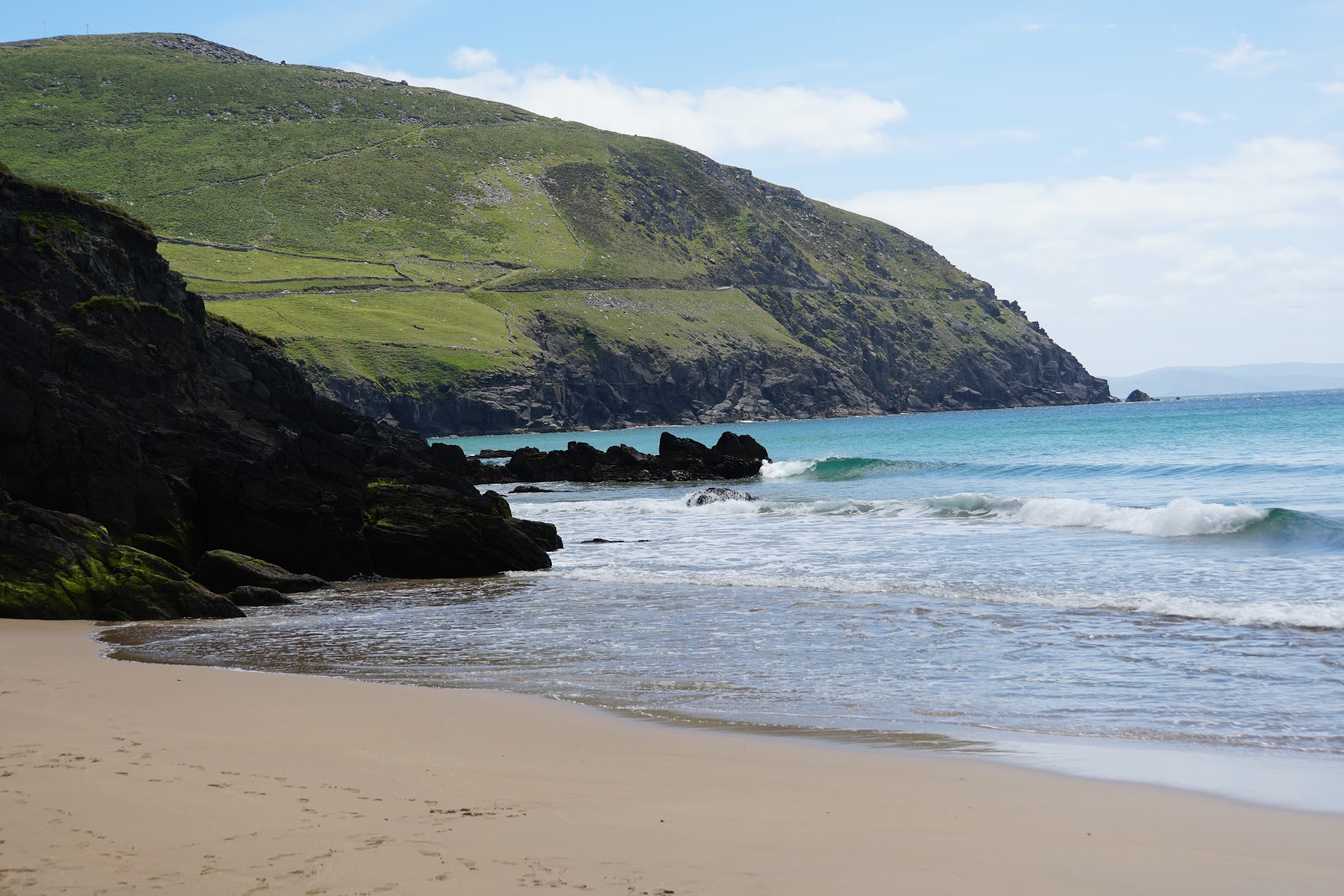
We took a car ride around the peninsula, the same "tour" we had taken with our dear Padraig Lynch in 1990. Coumenoole will always be a stunning place. It is featured in the movie "Ryan's Daughter."

Coumenoole, at the southwest tip of the Dingle Peninsula

Coumenoole


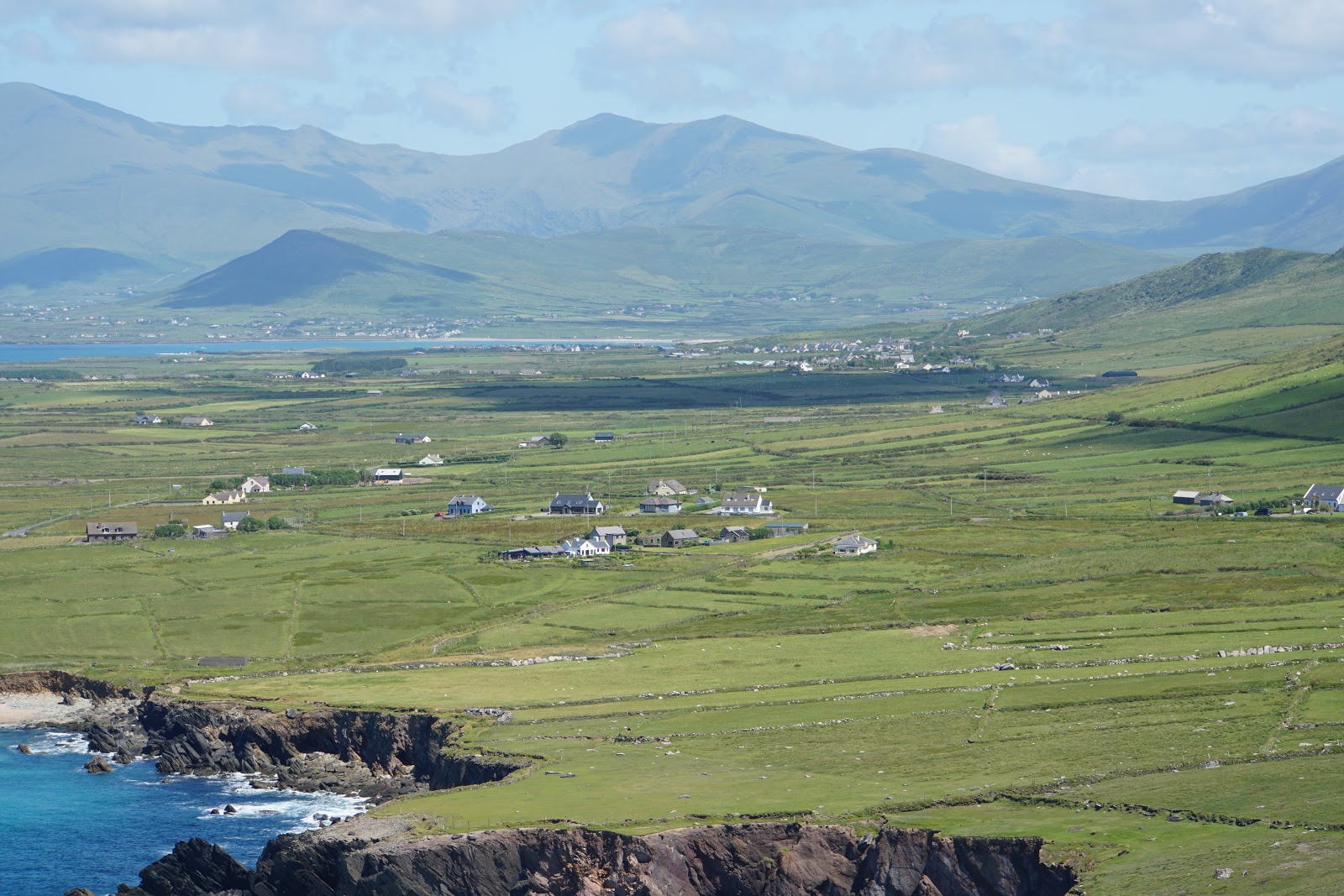
Slea Head near Coomenoole


Teeravane, north of Coomenoole; the domicile of the Ferriter family 


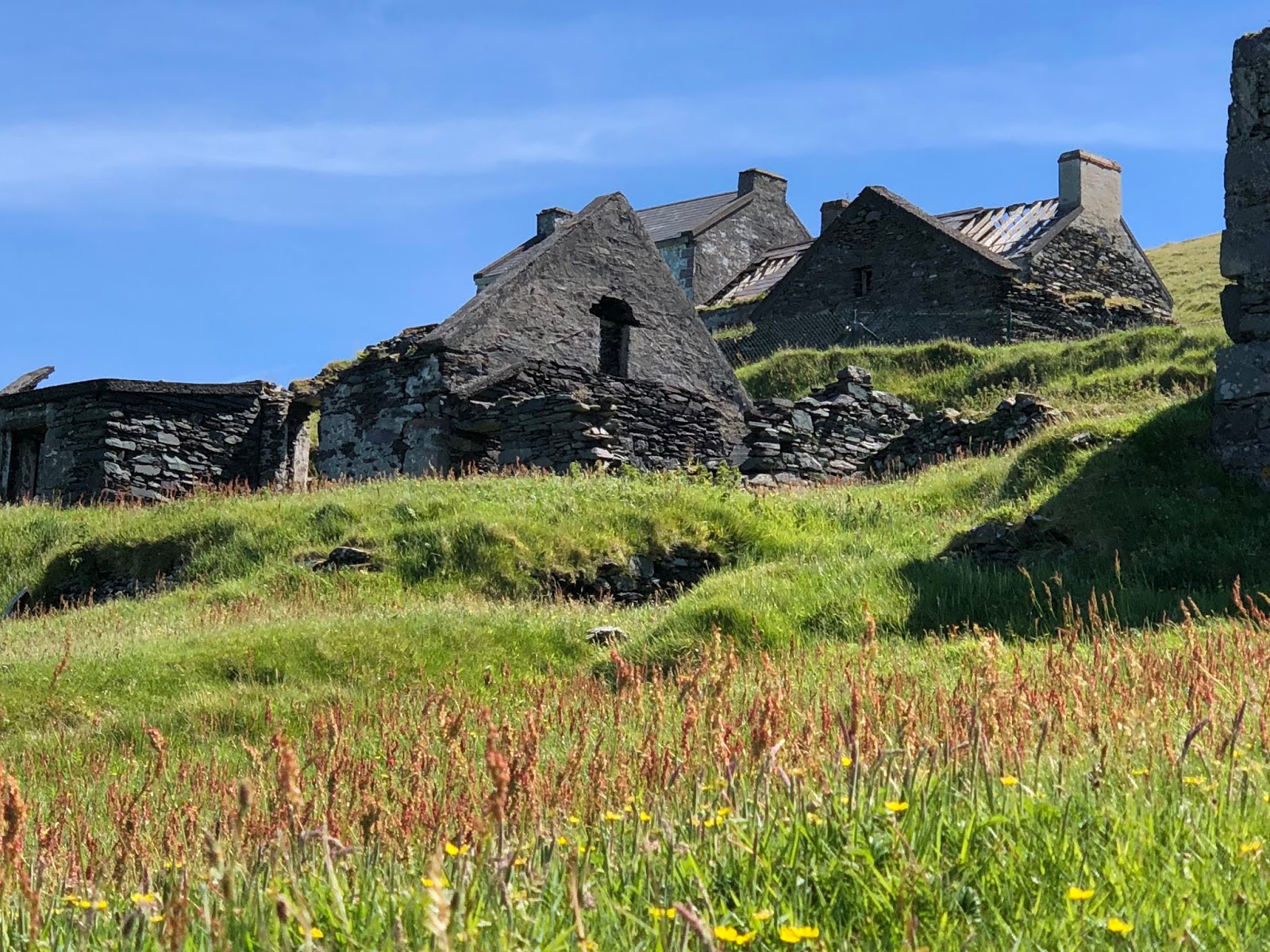
C and I took a boat out to Great Blasket Island, then hiked the 3-mile perimeter trail. The island was evacuated in 1952 as the government could not provide services to the small population left there. During winter storms the island could be cut off from the mainland for months at a time, even though Dunquin is only three miles across the water. The purest Irish in Ireland was spoken here. Well-loved Irish storytellers and authors, Peig Sayers and Maurice OSullivan lived much of their lives on Great Blasket. OSullivan's book, Twenty Years a-Growin' is one of my favorite books.

Great Blasket Island herd


abandoned village on Great Blasket


the village from above


beach on north end of Great Blasket


Atlantic view to the southwest from Great Blasket


our Dingle to Blasket boat is anchored at the right and the rubber raft delivered us to the landing 


boarding the raft to get back to the boat that returned us to Dingle


ocean cave on the Dingle Peninsula; even the Atlantic Ocean is green-ish on the coast of Ireland


sedum finds root in an ancient stone wall


Sunday, October 7, 2018

The Emerald Isle: Part 1, Dingle and Environs


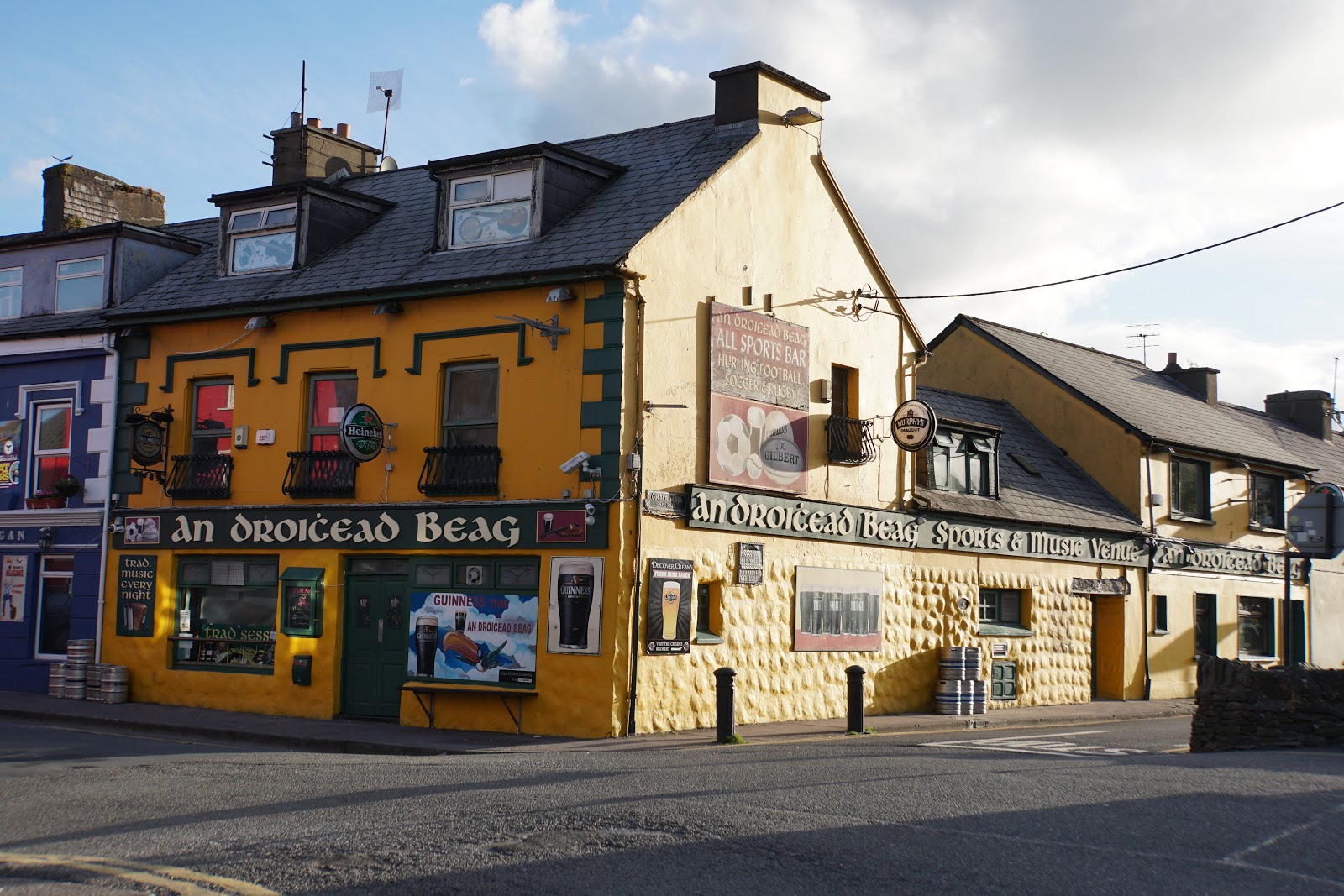
Main Street and John Street in Dingle
We had not seen this level of prosperity before

We spent a week on the Dingle Peninsula in County Kerry this summer. How much it has changed since our last visit 28 years ago (and our first visit 42 years ago)! What was once a sleepy fishing village is now a vibrant, energetic, colorful tourist spot. Huge tour busses wind down stingy narrow roads, hardly more than lanes meant for hay wagons. New homes and even whole new neighborhoods have popped up, buildings are freshly plastered and painted attractive colors, and businesses are thriving.


corner of Spa Road and Main and John Streets

My family names pop up on businesses all over town--Garvey, O'Sullivan, Murphy, Ashe, Shea, Sheehan, Brosnahan, Griffin, Kennedy, O'Connor, Baker, and so on. Not surprising, because nearly half of my ancestry comes from this area. Other loosely related names on signboards are Long, Moriarty, Walsh, Cronin, Curran, and even Walker.

 two more pictures of downtown Dingle


traffic jam on the Dingle Peninsula!


lighthouse at the entrance of Dingle Harbor


 you can still find timeworn tradition in Dingle


this centuries old bridge has a name which I now forget; one of my favorite things in the Dingle area


my third cousins; left to right, A, me, T, E; their brother J died suddenly two weeks before our arrival


 Gallarus Oratory hasn't changed in 1100 years


famine cottage a few miles west of Dingle, once owned by some Cavanaughs; my great-great grandmother was Catherine Cavanaugh from this area, but I don't know where her home was


we were accompanied by our long-time friends, B & C; we hiked up to this overlook near Dunquin 


C and B did a 75-mile bicycle ride around part of the Dingle Peninsula, including Connor Pass


we hiked up this headland (Bulls Head) above my ancestors' domicile of Kinard East; it became a tough trail, as it petered out into a mountainside of gorse, a pretty plant that deceives you with its buttery flowers--its true purpose is to afflict and torment man--and woman--with wicked inch-long sharp pokey stickers that embed themselves into clothes, shoes and socks


Bulls Head has amazing views!


Gorse, gorse and more gorse


Minard Castle east of Dingle; my 3rd great-grandmother (Nellie Wren) was born on the mountain above the castle; you used to be able to go into the castle at the peril of your life, but no more


Kilmalkedar Church, one of my favorite places anywhere, so ancient, so exquisitely built

detail of Kilmalkedar Church

Kilmalkedar Cemetery


Coming soon: Part 2, Scenery of the Dingle Peninsula