Thursday, November 22, 2018
Wednesday, November 21, 2018
2018 Finland!
the Aura River as seen from castle hill
We deeply enjoyed our summer visit to Finland! We stayed in an AirBnB a mile through the woods from B's place. We rode bikes everywhere, visited Castle Hill again and again, enjoyed the downtown sites and events, rode ferries between islands in the archipelago, and stayed in a humble cabin on one of the islands.
Baltic foot therapy on Russalo Island
this photo and the two following were taken at Flow Park, which is what we gave our three grandies for their birthdays; they had an amazing time, and even S was able to clip himself on and off the cables and enjoy it
we spent a day on this Baltic Beach (two photos)
Castle Hill, a five-mile bike ride from home; we rode here a lot (three photos)
the Medieval Market was set up while we were in Turku; here you see hand-made hobby horses that sell for big bucks
hike through the marsh
cycling on Russalo Island
decorating for the Fourth of July; we wanted to make sure our Finn grands know about this very special American holiday; we even held a short parade waving small American flags and included neighbor children in it
tree cutters working in the forest tagged this tree in B's yard for removal; the girls left a note on it (in Finnish), asking if the cutters could cut it into a seat, which they did; the neighbors next door did the same
castle hill
cycling at the harbor

marsh hike
Tuesday, November 20, 2018
DNA Inheritance, Simplified
https://creativemarket.com/schwegel/680255-Double-Helix-DNA-Strand
I recently gave a presentation on DNA testing to a community group. We discussed the types of DNA testing available (MtDNA, Y-DNA, Autosomal DNA) and then using the illustration below, I clarified for the group how DNA is passed down through generations.
There is a general misunderstanding that when siblings are children of the same parents, the sibling's DNA will be identical. When it is not (which is always, except for identical twins), some are convinced there has been a testing error. Another incorrect assumption is that because one has traced their ancestry on paper (through research) to particular places, and the DNA results don't match it exactly, the "science" must be bunk. In other words, "the company makes up DNA results just to collect my $99!!" Holy cow, social media teems with posts blasting the accuracy of DNA tests for the above reasons. But DNA is science, and science is real.
Let's look at the chart below which is from the Ancestry website. It's an ingenious way to explain how DNA passes down. First fact to know is that each child receives 50% of their DNA from their father, and 50% from their mother. Second fact: the parts of each parents' DNA that pass to their children are utterly random. You can see below that Edward received half of his DNA from each parent, represented by alphabet letters. Certain characteristics and features of each parent are contained in the DNA he has received. Other parts of one or the other parents' DNA did not pass to him. Same with Edward's wife, Angela.
Angela and Edward's children receive half of each of their parents' DNA, but as you can see, each child does not receive the same pieces. The children might resemble each other or share similar characteristics, and they will also have major differences. If the letter "N" represents perfect pitch, Glenda and Reagan will be musically gifted, while Gerald will struggle to carry a tune. Of course, this is a simplification.
Because Generation A's DNA is halved for their children--Generation B--and Generation B's DNA is halved for their children--Generation C, and so on, one could be only four or five generations removed from an ancestor and not receive any of their DNA. Some have become upset because their test doesn't show the Native American or some other ethnicity that they have been told about their entire lives. Even if you truly descend from Native Americans, it is reasonable that you might not have scientific evidence of it.
Some who have already researched their family back to say, France, are puzzled or distressed that they have only a small percentage of DNA from that area. They are convinced the test can't be correct. It's important to understand that because someone lives in a geographical area, it does not mean that their ethnicity is rooted in that place, and is the same as a neighbor's. Contrary to popular social myth, people did move around a lot in the past. If an ancestor lived in Paris, that does not make them ethnic French.
Though we understand nationality pretty well, it is not the defining characteristic of a person. Do we understand ethnicity? Ethnicity is what is in our blood, and what a DNA test reflects.
Rather than being bound by political borders (nationality), ethnicity is defined by language, culture, ancestry and even religion. My grandparents' nationality was Austro-Hungarian, later called Czechoslovakian after the establishment of that country. But their ethnicity was Carpatho-Rusyn, closely related to Ukrainian. Their native language was not Czech, Slovak, German or Hungarian, but Carpatho-Rusyn. Their ancestors had migrated southwest from Kiev, and their religion was Byzantine Catholic rather than Roman Catholic, as were their Slovak and Hungarian neighbors.
As time marches on, DNA testing for personal discovery purposes will become further refined. Perhaps eventually it will hone in on the time periods a person's DNA is found in a particular place, and become even more geographically exact. I would love to see more migration patterns delineated. The science is advancing rapidly. This knowledge could actually be displayed in the not distant future.
Because Generation A's DNA is halved for their children--Generation B--and Generation B's DNA is halved for their children--Generation C, and so on, one could be only four or five generations removed from an ancestor and not receive any of their DNA. Some have become upset because their test doesn't show the Native American or some other ethnicity that they have been told about their entire lives. Even if you truly descend from Native Americans, it is reasonable that you might not have scientific evidence of it.
Some who have already researched their family back to say, France, are puzzled or distressed that they have only a small percentage of DNA from that area. They are convinced the test can't be correct. It's important to understand that because someone lives in a geographical area, it does not mean that their ethnicity is rooted in that place, and is the same as a neighbor's. Contrary to popular social myth, people did move around a lot in the past. If an ancestor lived in Paris, that does not make them ethnic French.
Though we understand nationality pretty well, it is not the defining characteristic of a person. Do we understand ethnicity? Ethnicity is what is in our blood, and what a DNA test reflects.
Rather than being bound by political borders (nationality), ethnicity is defined by language, culture, ancestry and even religion. My grandparents' nationality was Austro-Hungarian, later called Czechoslovakian after the establishment of that country. But their ethnicity was Carpatho-Rusyn, closely related to Ukrainian. Their native language was not Czech, Slovak, German or Hungarian, but Carpatho-Rusyn. Their ancestors had migrated southwest from Kiev, and their religion was Byzantine Catholic rather than Roman Catholic, as were their Slovak and Hungarian neighbors.
As time marches on, DNA testing for personal discovery purposes will become further refined. Perhaps eventually it will hone in on the time periods a person's DNA is found in a particular place, and become even more geographically exact. I would love to see more migration patterns delineated. The science is advancing rapidly. This knowledge could actually be displayed in the not distant future.
Monday, November 19, 2018
Ancestry DNA Tests 2018
we're all connected in some way or other!
[http://sbims.com/membership-engagement-human-connection/]
When I first took the test nearly two years ago, Ancestry had outlined about 25 or 30 regions in the world, uniquely identified by DNA commonality. These regions were divided not by political boundaries, natural features or continents, but according to the uniformity and uniqueness of DNA found in residents of those regions. DNA samples from living people who have a long ethnic history in a region are the standard comparison, and to make it simple here, as your DNA closely resembles the deep-rooted samples from one of those regions, Ancestry can quantify what percentage of your ancestry comes from that area.
Currently Ancestry's regions have expanded to now number 350, thus their customer's DNA can be honed to a small area. Their sample populations have increased by a factor of at least three, further refining the matching process.
Here is my updated 2018 Ancestry DNA map showing my ethnicity. Look at Ireland, where 50% of my DNA originates. Notice the small circle drawn around the very most southwest part of the country. This is exactly where almost every one of my Irish ancestors come from. Now look at the leaf-green oval drawn around the point where Poland-Ukraine-Slovakia-Romania come together. 45% of my DNA originates from there. Both of these regions I long-ago identified as domiciles of my ancestors, and now DNA testing has corroborated that. Amazing!
NOTE: my only DNA surprise involves 5% of my DNA: 4% of that is Baltic, and 1% is from the Balkans.
Sunday, November 18, 2018
A Baffling Border Crossing
International border crossings range from the mundane US-to-Canada, or the current EU crossings, to the loony and absurd in the Middle East and "less-free" countries.
Crossings between states in the US are marked by boring greeting signs sending a wimpy welcome to travelers. The exception is when you enter California on a main entry point. All vehicles are stopped at an Agricultural Inspection Station. These are not immigration-related stations. You declare what fruits, vegetables or plants you are transporting. If they are on a suspected disease list, you either give up the produce immediately (yup, the fruit and veg you carefully picked out to sustain your crew on the road trip), or eat them in front of an inspector. We, being cheapskates, always eat our fruits in front of a uniformed audience.
But I digress. A couples of times we have had anything but mundane crossings. The most dramatic ones have occurred in the Middle East. Drama at a border crossing is not what you want.
the offending vehicle
We were staying with B's family in UAE, and planned to spend a few days in rustic, wild camper-outdoor-heaven: Oman. My husband worked on finding a company in UAE that would rent us a vehicle, but rental car companies just know you're going to be driving their shiny new vehicles on Oman's horrible pot-holed unpaved roads, and goats will be jumping on them, geckos crawling through them, and who knows what else. C finally found one that was willing to give us permission to take into Oman. All was well.
We made the eight-hour drive with two cars, J driving theirs and C driving the rental, both crammed to the brim with people and gear (seven of us). On reaching the border we completed the first step of the two-step entry process. But when C hopped back in the car to proceed to step two, the engine wouldn't even turn over. This was a new-ish rental car with a full tank. He and J did what guys do in these situations, and stuck their heads under the hood to ponder our plight. Nothing seemed wrong with the engine. The car ran beautifully until it didn't.
After a while C reported the problem to B back in UAE. She had remained behind for a day. She was scheduled to catch a flight into Muscat, Oman, where we would pick her up later in the day. She called the rental car company to report our problem, and I don't know what all went on in that conversation. Am sure she garnered their sympathy by explaining seven members of her family were stranded at the UAE-Omani border with a non-operational vehicle, their camping trip to the wilds of Oman in peril. Well, she probably left out that last part as it would make the company sad and not want to help us.
Some back-and-forth conversations occurred, and those of us parked at the border found ways to pass the time. The girls prayed the car would run again.
Then B called to report that the rental company in UAE had figured out what happened, and had fixed the complication. Apparently there is an electronic feature on the car which can be programed to make the vehicle non-functional in undesirable places. The company had neglected to turn off that feature. The car had obediently ceased working at the Omani border, just as the software told it to.
And that was that. The engine came to life and off we went! We lost over an hour but had clear sailing in beautiful, rugged Oman.
A few photos of that fun camping trip on the shore of the Arabian Sea:
Saturday, November 17, 2018
Spanish Flu epidemic
Tennie Myrtle Sellers and Thomas Philas Marlar, October 14, 1897
My husband's great-grandmother, Tennie Myrtle Sellers Marlar (1880-1919), died of influenza on January 10, 1919 in a rural town called Aquilla, Texas. She left behind five children from age 18 down to age 6. None of her grandchildren ever knew her but they know her end story. They say she took care of other family members with the flu, and when it came to her, she couldn't fight it through her exhaustion. It is true that the young and healthy were more likely to die from Spanish influenza.
I asked my Baba (1890-1990) about her experience during the influenza; she caught it but my grandpa did not. The severity was what set it apart from any other illness she ever had. For three weeks she was so ill in their boarding house in Monessen, Pennsylvania, that she thought it was the end, and even wished at times that she could die. For a young mother to feel that way indicates how awfully sick influenza made her. No one dared come into their home to help her except an Italian neighbor who brought in a hot water bottle. Presumably she brought in food also. Baba had three of her own children and had charge of her deceased sister's children as well.
Baba told me that her baby George (1917-1918) died of diphtheria. She even described the gasping for breath that tortures those dying of diphtheria. When I found his death certificate the cause of death was listed as influenza. Diphtheria wasn't mentioned. Perhaps the influenza caused the same gasping for air. We don't even have a photograph of little George.
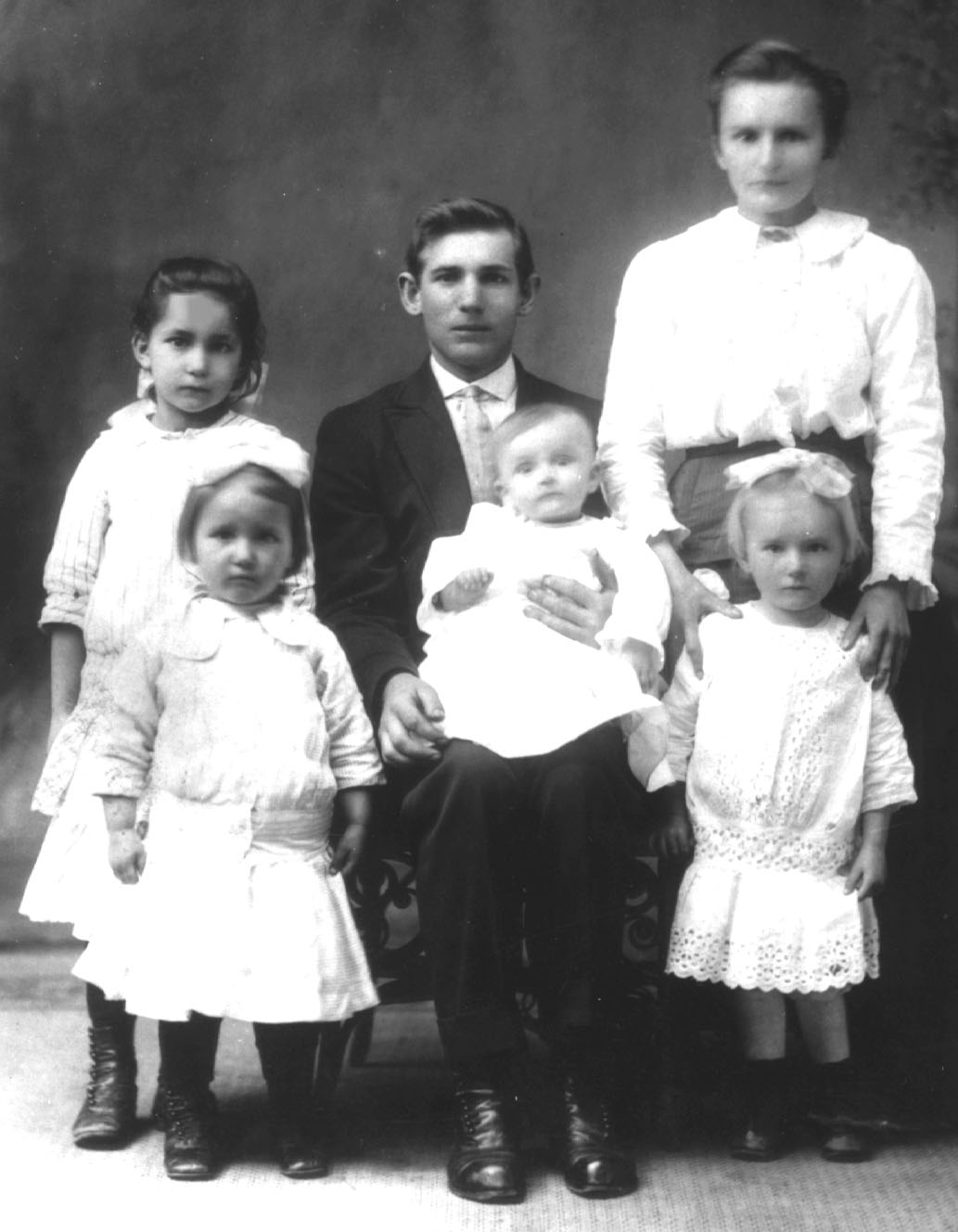
Baba and Grandpa with their baby John and daughter Mary, spring 1917
the two children on the left belong to Baba's deceased sister Anna
Baba mentioned that at the time of George's death and of the influenza, coffins were stacked in the cemetery awaiting burial. Healthy men were in short supply so the coffins sat. And who can even say how many deceased waited at the undertaker's parlor because a coffin shortage existed? In some places formal funerals were prohibited to prevent the spread of influenza. Schools were closed, churches suspended services. I don't know about George's burial. If Baba was sick at the time of George's death she wouldn't have gone to the cemetery.
Pittsburgh and its environs was hit harder by flu than any other American city of the same size. The population's health was already compromised by industrial pollution which might explain why the flu's death rate was on the high side. Hundreds of children were orphaned.
Europe was ravaged by Spanish influenza. Baba's older brother, Michael, had returned to Europe with his wife Mary and family in 1915. They survived the war years only to lose several children to influenza. Aching in agony, Mary wished they had never returned to their home village. The conditions must have been dreadful. The physical and emotional scars of war and the accompanying afflictions--starvation, homelessness, disrupted transportation and services--were bad enough. Then the pestilence swooped in on them.
With the annual development and availability of flu vaccine, such a scourge should not happen again.
Subscribe to:
Posts (Atom)