Showing posts with label Vermont. Show all posts

Friday, July 22, 2022

John Francis Brosnahan's Final Resting Place


Oise-Aisne American Cemetery; Block A, Row 39, Grave 6


Forty-some years ago while wandering through the Catholic cemetery in Brattleboro Vermont (my Irish ancestors are buried there),  I spotted a memorial plaque to a man named John Francis Brosnahan. Several marriages in my ancestral family are with Brosnahans, yet I had not heard of John Francis. The plaque reads:

BROSNAHAN 
In Loving Memory Of
Priv. John F. Brosnahan
Co. L   306 Inf 
Who Gave His Life in France
For His Country
Buried in Fismes, France

The family gravestone adjacent to the above adds more information: 

Sept. 9, 1887 
John Francis
Aug. 19, 1918

I dug right in to find more about John. He was born down the road from Brattleboro on a farm in Vernon, Vermont to Irish immigrants, Patrick Brosnahan and Catherine Brosnahan (yes, that's her birth name). Old issues of the Vermont Phoenix newspaper mention details about John's earlier life. He had an excellent school attendance record. He played football at Brattleboro High School and held down a job at Fenton's men's furnishing store. After graduation he took bookkeeping courses at Albany Business College and then found employment with Hall, Hartwell & Co. in Troy NY. According to the Phoenix, he made regular visits home to see his parents and siblings in Brattleboro. By 1911 he was living and working in New York City at Hanover Exchange Bank, and then at B. Altman & Co. department store. He remained single all his life.

Brosnahan received his draft notice in August 1917 and went into training at Camp Upton on Long Island on October 10. His rank was Private First Class in Company I, 306th Infantry, 77th Division. On April 16, 1918 he sailed for France with his company on the steamer Kashmir. 

By August that year American troops were facing German troops along their defensive lines at the Vesle River near Fismes, France. Full-scale battle was fought from August 3rd to September 1st with terrible loss of life. German howitzers were dropping shells among the American lines, hidden German machine gun nests poured fire onto advancing troops, and flame throwers were so effective that the town of Fismes was destroyed.  

On August 19th, 30-year-old Private Brosnahan was killed by shell-fire. His commanding officer, Captain Earl Marshall, mentioned in a letter to Brosnahan's mother that he was "apparently killed instantly by the explosion of a shell." My first thought was this simple explanation was to spare widowed Catherine any thought that her son suffered, yet the documents relating to his death use the word "none" in the space where wounds would be documented, indicating he probably didn't know what hit him.

John's last letter home, written August 3, carried the remark, "The soldier's life is a great life." We know that combat was fierce on French soil in the summer and fall of 1918. Trench warfare and constant shelling and sniper fire made a soldier's life horrible, but which man was going to confess fear and misery to his distressed mother at home?

Deceased soldiers were first buried in temporary ground near battle sites, and then moved to other accommodations as conditions allowed. Brosnahan's remains were moved several times until the establishment of Oise-Aisne American Cemetery near Fismes in the early 1920s. At this time families of the fallen were given the option to have their soldier brought home for US burial, or to be buried among comrades near where they fell. In this cemetery just over 6000 Americans were laid to rest, and though the specific reason for the Brosnahan family to make this choice is unknown, it was a common one. Tens of thousands of Americans are buried in France.

On our visit to Oise-Aisne we identified ourselves as family of an interred soldier. The superintendent -Bert- pulled out all the stops. He gave us copies of documents pertaining to Brosnahan's military service. Bert handed us American and French flags to plant on the grave, and carried a small bucket of damp sand from Omaha Beach as he accompanied us out to the grave site. He showed us how to rub the sand across the stone's inscription to make it more visible in photos, and we planted the flags in front of the grave, as seen in the photo below. I'm positive we are the first family members ever to visit Brosnahan's grave. Of all the things we did and saw on our European visit this summer. honoring a fallen soldier was the most moving and satisfying.

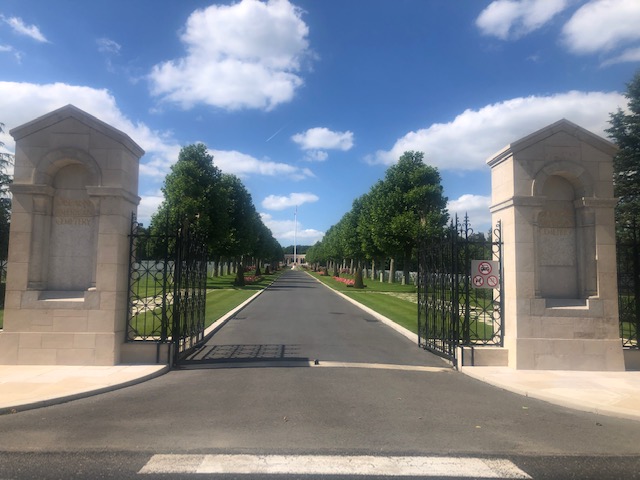


entrance to Oise-Aisne cemetery


a portion of the 6000 burials in the cemetery


map showing the various American divisions' participation in the battle; John Brosnahan was in the 77th Division


NOTE: for more about John Brosnahan click here

Friday, November 3, 2017

Really Bad Remodel


This awesomely bad remodel job is on South Main street in Brattleboro, Vermont. It doesn't help appearances that the house is in derelict condition, but seriously, to throw on a hideously awkward extension onto the roof of the front porch?

Typical of the 19th century, house lots here were deep, yet narrow across the front. It makes sense, as before auto transportation people relied on foot travel for commuting to work and taking care of business. Thus towns were built compactly, houses close together.

Slapping additional rooms onto a dwelling was a common practice. Because lots were deep, extensions were built onto the back, one after the other. I've seen some old homes with as many as 5 different extensions in the rear. Subsequent additions rarely match what's already there. It gives the impression that the owner rolled out of bed one day and decided it was time for another addition, then used whatever materials were at hand.


Sunday, November 1, 2015

Oh Yeah, Never Walk on the Railroad Tracks

(amended quote by Phil Connors (Bill Murray) in "Groundhog Day")
 
In October of 1970 I and some of my friends nearly became a statistic when we foolishly sat on the railroad tracks of a busy train route that ran along the side of the mountain behind my friend's house.  This friend lived on a large piece of property that could accommodate the construction of our high school class's annual homecoming float.  The float consisted of rolls of chicken wire (usually swiped from a construction site) shaped over a car, and then thousands of Zee paper napkins bunched up and stuck in the holes of the chicken wire in some kind of pattern.  Yeah, it was a real beaut.  Keep in mind that paper napkins only came in white, washed out pale green, washed out pale blue, and washed out pale pink.  Stunning as the float was, we never thought to photograph one of those gems.

Anyway, it was common for the other classes to seek out their rival's float to throw eggs on it.  This one night we heard through the grapevine that the seniors were on their way to wreck our float, and we being as smart as all get out, climbed the hill to the tracks to keep a lookout for the perps on that pitch black night.

Nothing happened where the float was concerned.  But there we were sitting ON the rails when all of a sudden a train rounded the bend, and it was all we could do to leap off down the berm as it passed by.  It seems unbelievable, but we never felt the tracks vibrate, nor did we hear the rumbling of the train as it barreled toward the curve.  Suddenly, there was the powerful beam and the train was upon us.

This memory came back to me because while doing some research recently, I saw this death record of 3 young Irishmen killed in a railroad accident:

A portion of the Chicopee Massachusetts death register dated 25 Sep 1895:

 
I had to know what happened.  The accident likely occurred during the course of rail construction gone wrong, a common method employed by the grim reaper to make his mark.  A search on www.newspapers.com showed this was not the case:
 
 
 The Atlanta Constitution September 27, 1895 Page 3.  A similar article appeared in papers around the country.

Golly, these 3 grown men were walking on the tracks, then carelessly attempted to cross an adjacent set of rails without looking first.  What a sad end.  One wonders if they had a split second to regret their mistake.

 Railroad-related deaths were once common.  Railroad laborers were killed in construction mishaps, while coupling cars, and while switching engines or cars.  Brakemen were killed falling off the caboose or while working the brake and not noticing that low bridge ahead.  Engineers and passengers burned to death in train wrecks when the oil lamps were upset and caught fire.  Derailments caused injury and death when severe weather undermined and destabilized the tracks, causing trains to leap off at top speed. 

My great-great grandfather, Cornelius O'Sullivan, was killed on the tracks in Brattleboro, Vermont in 1877.  The account of the accident made it clear he was the class of railroad employee they now call a lineman.  He was on a handcar, and when it lurched on the track he was knocked off to the rear, and then run over by a following handcar.  It must have tumbled him around underneath, leaving him with severe injuries to the back, lungs, and a broken leg.  He lived 5 days in that condition.  I don't know how the family got by after his death.

 1870-style handcar (http://www.micronart.com)


later handcar

Thoughts of Cornelius O'Sullivan's pain and suffering haunt me every time I drive past the spot of the accident, which I did last week.  The newspaper reporting the accident did not make it clear whether he was brought home to be treated, or taken to the nearest house.  I have a copy of his will created 3 days after the accident and 2 days before his death.  He left everything to his wife Catherine and signed it with his mark, the letter X.  He was laid to rest in the Catholic Cemetery on the hill beside his deceased children.  And resting nearby are a handful of others who also lost their lives due to railroad-related accidents.


Tuesday, November 11, 2014

Luke Ferriter, Civil War Veteran

In honor of Veterans' Day, let's go back in time to the Civil War.  Irish immigrants made an important contribution to both armies, Union and Confederate.  Below is a life sketch of one of those men.  His name was Luke Ferriter, and he ran away from home to join the Union Army at age 16.


from the Brattleboro Reformer Newspaper about 1916

Luke lived a life of adventure tinged with sorrow.  His early years were spent in Ireland without his parents.  They had left the Emerald Isle during the Famine years to find work and he joined them in Vermont when he was 12 (about 1857).  To get to the US he endured a shipwreck, losing what little he owned, and on arriving in New York was dismayed to find that no one knew his parents.  Perhaps that's to be expected from a naive native of a tiny Irish hamlet who was used to everyone being acquainted with everyone else.  This 12-year-old boy made his way to Massachusetts where he discovered his parents had moved to Brattleboro Vermont some years before.

When war broke out in 1861, Luke's father forbid him to join up.  Luke ran off to Springfield Vermont and signed up under the name Charles Smith.  When the train full of recruits passed south through Brattleboro, Luke hid in the lavatory while his father searched the train for the rascal.

Over the following four years young Ferriter participated in plenty of action.  Many times he heard bullets whiz close to his head, or saw them plow into the ground at his feet.  A piece of shell shattered his gun giving him a neck wound.  At The Wilderness bullets ripped through his clothes without leaving a scratch.  A thigh wound occurred at Spotsylvania that was severe enough to send him back to Brattleboro for a stay in the military hospital.  I've wondered if either of his future wives helped nurse him back to health there.  Luke gained local fame for capturing an officer of a South Carolina outfit, and later a member of the Confederate rear guard.  

After the war Luke married Ellen Martin who was also an Irish immigrant.  As members of Brattleboro's closely knit Irish Catholic community, they would have known one another in their teens.  Ellen died delivering her third child in 1871.  A second marriage, to Eliza Anne Fenton in 1873, lasted 53 years.  Those two also knew each other as teenage Irish immigrants.  Four of their children died very young, and a son Andrew, died at age 18 when he tumbled out of the loft of the local livery stable.  What a crushing blow.  Five children survived to adulthood.

Luke Ferriter's granddaughter, Catherine Ferriter Rogers, told me that he preserved his Civil War uniform, and enjoyed regular invitations to local classrooms to talk to students about the war.  He must have enjoyed dressing the part of a soldier once again, and reliving the excitement and danger of battle, and of his notable exploits.  That uniform is now owned by some of his descendants in Rhode Island.

In Luke's later life he wore many hats.  He worked as a factory fireman, on the railroad, as a cigar maker, and for a shoe manufacturing company.  He was active as a volunteer fireman, led the local post of the Grand Army of the Republic (the Civil War Veterans organization) and he worked for temperance among the Catholics of Brattleboro.  Later on Luke and his wife took care of an elderly single Irish woman for several years until her death.

81-year-old Luke Ferriter (on right) discusses his Civil War experience with a writer
(from the Boston Herald Newspaper via http://irishamericancivilwar.com)

I admire and appreciate men like Luke Ferriter who threw themselves full bore into harms way.  They had much to lose.  Ferriter was one of the lucky ones who returned home in full health, and lived a long life supporting his family and contributing to the community.


Saturday, November 9, 2013

An East Coast Adventure, or My 2 Days As a Fugitive From the Law


For Craig's sabbatical in 1990 we planned a month-long vacation traveling a loop in the East, beginning and ending in South Carolina.  My children and I flew to Columbia SC to start our big adventure; Craig would join us later in New England.

We picked up a Budget rent-a-mini-van and headed north, stopping in Virginia for the night. It was there in Virginia that I noticed there were no license plates on the car. Not in front, not in back. Mmmm, they do things different here. I didn't worry much; if the rental company left the plates off their vehicle it must be ok, right? Not my problem . . .

We spent several days at my Baba's in Pennsylvania, then continued on around the northeast through six more states. I recall passing several Massachusetts state troopers who didn't seem to care about my vehicle sans plates. But in Vermont, they cared.  I hadn't been in the state 15 minutes before being pulled over in Brattleboro, the home of my Irish immigrant ancestors. In fact, I was pulled over just down the street from where my Sullivans and Toomeys used to live.

Elliot Street in Brattleboro; my gr-grandmother was born at the end of the street (out of view)

Ms. Policewoman brought to my attention the missing plates and asked for the registration.  Surprise!  Another Budget blooper--the glove compartment was empty. I offered her the only document I had: the rental agreement. It was against the law to drive without plates or registration, duh, and she could take the car from me right then, yikes. But she peeked inside the car, saw 4 wide-eyed children with all our junk, and said she wouldn't do that. The deal was, she would meet me at my hotel to write a citation (and I made sure it was going to be to the rental company), then I was not allowed to drive the car except to go to a Budget  rental-car location for a switch the next day.

The nearest Budget was in Greenfield Mass. an hour away, but I could visit my cousin Maureen in her Catholic convent in West Springfield on the same trip, so no harm done. Turned out the Greenfield office was closed that day, a Saturday. At Maureen's convent I spent a good 45 minutes on their phone attempting to find an nearby Budget office that was open. The closest one was down at Hartford/Springfield (BDL) airport in Connecticut. My research time in Vermont was going to be sucked up fixing this stupid rental car mess. But wait, I was going to pick up Craig at BDL in a couple of days anyway. My choice then, was to live as a fugitive from the law for the next few days, because I darn well wasn't going to squander my vacation making 2 trips down to BDL.

So back to Brattleboro we went. I cautiously stayed within the speed limit on back roads to get there. I parked in obscure spots hidden from the road. While I transcribed gravestones at the cemetery the car was secreted behind shrubs. Not a good feeling, to know I was disobeying a cop, especially one who gave me a break, but the whole thing was a dumb error on Budget's part, not mine.

UGH

2 days later at BDL I told Budget they could have their illegal vehicle back and replace it with an identical one at the same rate. And they could have the ticket too. They whined and fussed, but in the end gave me what I wanted, and the ordeal was over. My life as a fugitive from the law had ended, and all was well. This was not the last time I was to have a negative experience with a Budget rental car, and that will be a story for another day.


Saturday, November 24, 2012

Antique Postcards

A few years ago I began buying up old postcards of places that were important to my family and our history. We have few photographs of our ancestors, so the next best thing to pictures of our people is a picture of the places they lived, worked, and worshipped. Companies created postcards of the most average mundane scenes, which is a bonus for people like me who buy them for family reasons. I don't need a postcard of the Golden Gate Bridge, for instance, because it doesn't have significance to my family. But a postcard of a the coke ovens in Star Junction, Pennsylvania? I'll pay bucks for that one!

Ebay is ideal for this. There's many for sale and if you wait long enough, a postcard of the exact place you want will pop up. Some examples:

Powers Institute, aka Bernardston Academy, is where my great-grandfather Michael Henry Toomey attended high school circa 1876. It still stands, now as a museum. The photo is probably from the early 1900s.


 A view of South Vernon, a railroad junction that straddles the state line of Massachusetts and Vermont. The building on the left is the old hotel, which is still there, and was new when my Toomeys lived in South Vernon in the 1870s and 80s. This quaint view has been altered by a modern a highway.


The dangerous intersection of three bridges north of Brattleboro, Vermont, late 1800s. The writing on the bridge says "Walk Your Horses." This junction was modified after some terrible accidents between trains and horses. My Toomey and Sullivan ancestors would have passed through here once in a while.


The Brooks Free Library, Brattleboro VT in 1910. It was built in the 1880s when some of my family would have borrowed books (I hope). What a pretty picture of the first real library in town. It has long since been replaced by a modern, but less attractive library.


A public school close to my Grandma's house in Brooklyn, NY. She lived on the corner of 4th Ave. and 78th, so this may have been where she attended. If not this one, then one a lot like it.


Even photographs of events such as parades and fairs were sold as postcards. This one of the local county fair in Brattleboro, called Valley Fair, I believe was taken pre-1910. Fairs, lectures, church socials, traveling circuses, and post-Civil War GAR events were our ancestor's entertainment, and you can find postcards of just about all of those events.


My Mom grew up in Washington Heights on Manhattan, not far from this library, immortalized in a postcard circa 1900.


The Dellbrook House in Perryopolis, PA, circa 1950, built by my step-mom Hazel's then-husband in 1948. In 1996 Dad married Hazel and moved into this house. In 2001 the stairs became too much, so they sold it to my brother who lived there until 2007 ish. This postcard is entitled Modern Perryopolis, the Carl Dellbrook House and is still sold in the local drugstore.

Monessen PA's Greek Catholic Church, which my grandparents attended about 1918-1921. Nice that someone thought to make a postcard of it.


This postcard pertains directly to my life. Beale Cut, aka Fremont Pass, aka San Fernando Pass or Newhall Pass, near Newhall, CA. When I was growing up it was a major thrill to climb down into this cut which was made for the Butterfield Stagecoach Line, about 1863. This was the original road from Los Angeles to San Francisco. On the other side of this cut was the local oil refinery. I remember the thrill of finding shell fossils in the side of the cut. It is badly eroded now. And it is seen in plenty of old western movies.


Friday, November 23, 2012

Unsolved Family Mysteries

When you have worked on family history for as long as I have, you are bound to run into intriguing mysteries, some solvable, some elusive, and some downright maddening.  Here's just a few I have solved or am still facing.

UNSOLVED
My Mom told me about the mysterious case of Tom Brosnahan, her father's cousin. He was in college at a Catholic seminary, and, suffering from intense overwork, came home for some R and R. He stopped by to visit Mom's family in Massachusetts, and after that was never seen again. Mom could barely remember this; she was born in 1926, so a likely time period for the disappearance could have been about 1930-ish. To this day no one knows what happened to him, despite the investigations done at the time. The police even dragged the river looking for a body. I have done some fishing, but without actually visiting Massachusetts and devoting days to searching police records and other public documents, it will remain a dead-end. As much as I yearn to solve the case of disappearing Tom, it would be a better project for someone who lives in the area and wouldn't have to rack up hotel bills and use vacation time.

UNSOLVED

Michael Toomey, my great-great-great-grandfather, came to Brattleboro Vermont from Ireland about 1848, and likely worked on the railroad there (no direct evidence for that, yet). His gravestone says he died April 9, 1870. Gravestone information is notoriously in error, but supporting evidence for that death date is in the town's tax records for that year, dated April 15, 1870. Michael's name is entered, then crossed out with "dead" added next to his name. But there is no death record for him found in Vermont at any time. I have checked all of the surrounding states and found no death record for him.  Such a record would give me his occupation and his cause of death, about which I'm very curious. 

SOLVED

 George, John, Andrew, Michael Bubnash

 My Baba told me that my Grandpa's father, Paul Bubnash, died when Grandpa was a baby (he was born 1891). Yet some cousins in Montana showed me a photo taken circa 1900 of four of the Bubnash brothers, and they were sure Paul was the one on the left. This info was passed down to them from the previous generation. My instincts trusted Baba; she was very good on details. I was sure Paul Bubnash couldn't have appeared in a 1900 photograph. Finally, about 1996 the parish records of Valaskovce, Austria-Hungary, became available on microfilm. I dove right in looking first for Paul's death. And yes, he died at age 28, before my Grandpa was even born. Two months before my Grandpa, his second son, was born, in fact. And who was the man on the left in the photo? My Slovak relatives tell me it's the oldest brother, named George. And that makes perfect sense.

SOLVED

My Baba also told me the circumstances of her brother Michael Csornej-Maczko's death. Briefly, Michael was living in their native village of Nemet Poruba during the war. The Germans marched through and forced the residents to flee or be shot. They fled to the mountains on the Polish border. When residents returned to the village they found it burned to the ground. Michael lit a fire for warmth, in what remained of the chimney. The Germans had planted a bomb in the shaft, it exploded, and Michael was killed.  o which war was this, I asked Baba. She just couldn't remember. She was near 100 years of age, and some details of things that had happened to other people had naturally faded from her memory.

In 2002, we visited Dukla Pass in Slovakia, the site of "the biggest battle you never heard of." Over 100,000 people were killed when the retreating Germans, pursued by the Russian advance, made a last stand at Dukla Pass on the  border between Poland and Slovakia, from October--December 1944.  Learning what happened at Dukla Pass was the key to solving the mystery of when Michael died. As I studied military maps of battles that took place in Eastern Slovakia, and read the rare accounts of people's experiences, everything fit for Michael's death occurring in December 1944 or January 1945, and definitely not during World War One. The pattern of the German retreat near the end of World War Two was repeated all along the front: banish or kill the villagers, burn the village, leave behind murder and mayhem. Baba knew Michael's death occurred in winter. Many innocents were killed during the fighting at Dukla Pass.

SOLVED

In the mid-70s I located a death record for my great-great-grandfather, Cornelius O'Sullivan.  He was 51, died in Brattleboro Vermont, and his death was listed as accidental. I was able to get someone in Vermont to check an the June 1871 Vermont Phoenix newspaper for a report on the accident. A terse couple of lines in the paper explained that Cornelius was "run over by a hand-car just above the West River Bridge." He lingered five days until his death. That's it.

Fast forward years later. Curiosity about what happened had been eating at me. I was in Brattleboro Vermont and found bound copies of an obscure short-lived newspaper called The Vermont Record and Farmer. This one shed more light.  Poor Cornelius was one of a group split between two handcars, who rode up and down the track checking its condition. He was on the lead car. It hit an obstacle large enough to cause a lurch; he fell onto the track and was run over by the rear car. His injuries were dreadful. About the same time, I discovered a handwritten piece of paper in an old book that had belonged to Cornelius's daughter, my great-grandmother, Mary. On it was written a list of terrible bodily trauma without any reference to whose injuries were described. I am sure they were his.

Mary Sullivan, daughter of Cornelius O'Sullivan

Sunday, February 12, 2012

Happy 150th Birthday!

One set of my great-grandparents are now 150 years old. Michael Henry Toomey was born 24 September 1861 in Brattleboro Vermont, to Irish immigrant parents (John Toomey / Mary O'Donnell).

MHT's father and grandfather worked on the railroad. I'm not sure of his father's job description, but the family moved up and down the railroad line in the 1860s-70s-80s. Some of MHT's siblings were born in other SE Vermont towns such as Putney, East Dummerston, and South Vernon, which was the main railroad junction in the area. The curious thing about South Vernon is that it straddled the state line between Vermont and Massachusetts. His two youngest siblings actually show up in both state's records. Perhaps the family moved to a house across the road, putting themselves in the neighboring state.

MHT attended high school at the Bernardston Academy in Massachusetts. He left there to become a railroad brakeman, one of the most dangerous jobs around. In those days brakemen rode atop the caboose where the wheel-brake had to be manually turned. Many a brakeman was knocked off by low bridges or lurching train cars. As the story goes, he was injured on the job, and during his recuperation worked in the railroad office where he learned the skill of telegraphy. And telegraphy became his life's work.  

About 1880 MHT began work as a telegrapher in Greenfield Massachusetts, then in Boston. By 1884 he was working in New York for Western Union, and at some point moved to the New York office of the Boston Globe Newspaper. By the time of his death in 1901 he ran the night-wire service for that paper. And he was known as one of the country's fastest telegraphers.


Mary Catharine Sullivan was also born in Brattleboro to Irish immigrant parents, Cornelius O'Sullivan and Catharine Cavanaugh, on 13 February 1862. Her family lived in the Irish patch on upper Elliot Street, then in 1870 bought a small two-level house on Clark Street that still stands. The backyard had a small apple orchard. Some of the Sullivan relatives also lived on Clark St.

When Mary was 15 her father was run over on the train tracks north of Brattleboro. I can imagine the horror and distress of his broken self being carried home to die.

Mary and MHT attended some of the same Brattleboro schools during their early years, but once his family moved to South Vernon I don't know how often they saw each other. After he began his career as a telegrapher in distant cities, I wonder how often he got back to Brattleboro for visits. And I wish I knew at what point they began courting and decided to marry.

At St. Michael's Catholic Church in on 1 September 1885, she and MHT were married. Mary left her job at a local Brattleboro business, Leonard and Roess Cigar Shop, whose employees gifted the happy couple with a china tea set. They honeymooned in Boston, then moved to Brooklyn New York. Mary returned to Brattleboro to have her first two children, Kitty (1886) and Harry (1888); the other six were born in Brooklyn--Ed, Gert, Frank, Alice, Marian, Charles.  The family bought a house in the Bay Ridge section in the 1890s. They were able to afford music lessons and other niceties. Harry and Charlie both died as toddlers.

MHT's early death on 26 December 1901 at age 40 had far-reaching effects. Some family members suspect MHT had debts to pay off from stock market losses. The newly-impoverished widow went to work as a nurse. My grandmother Alice and her sister Marian were sent to live with MHT's mother, further east in Brooklyn. Frank was sent to St. John's Boys Home. The family was able to keep their house; in the late 19-teens they moved into a Brooklyn apartment.

Two months before her death in 1930, Mary had retired, was living with her youngest daughter who probably helped pay the $50/month rent on their Brooklyn apartment. They owned a radio according to the US Census. She is buried in Holy Cross Cemetery in Brooklyn next to Harry and Charlie.


Sunday, November 13, 2011

Vermont Adventure


Middlebury Vermont . . . the quintessential New England village. Snow white, pointy-steepled Congregational Church, tree-sy village green, 19th century mills, gushing waterfalls that once powered those mills, 200+ year-old university, prehistoric two-story Ben Franklin five-and-dime store. Church bells ringing on Sunday, traffic moving 20 mph, John Deere lived here, tight country roads with one-way bridges, Robert Frost's farm just down the road, and a writer's group called Bread Loaf.


I spent a delightful two weeks here in 2008 with Bridget's family. They were living in student housing for the summer while Jeremy taught Arabic at Middlebury College. Bridget was expecting child #2 at any moment, and I came to help out. Every day and usually twice a day I took Meme via stroller on humid, drippy walks downtown to the library or the Ben Franklin, or to watch the surging, muddy falls. Meme loved churches and occasionally we'd stop to explore inside one of them.

 looking north on Main Street

Because Bridget's family was living in student housing there was no room for me there. The price of hotels/motels was quite high here so I decided to camp out at a family-owned campground a few miles down the road, for $20 per night. I brought along my Fred Meyer $13 tiny tent, a homemade fleece sleep sack, bought a pillow in Middlebury, and was all set for a 2-week camping adventure. 


But I didn't plan on the rainiest summer that living Vermonters had ever seen. Who could have guessed? And it wasn't just a deluge; these daily/nightly storms were full-blown t-storms, the clamor of a violent bowling match played in the heavens while Zeus hurled lightening bolts at the Titans. Some nights it was so thunderously deafening (and frightening) that I had to take ambien to sleep. The water flowed in sheets through my campsite. The falls in Middlebury attracted crowds who had never seen them surging so strong. 

Middlebury Falls

And despite the torrents I managed to stay dry inside my faithful tiny tent. After a couple of nights tiny tent wasn't leaking, but I feared it soon could be. With a pile of hefty bags and a roll of duct tape, I fashioned a waterproof cover for it.  Not even a drop of water would dare get in this tent. And not one ever did.

I still use my sturdy tiny tent for backpacking trips. And I enjoy the satisfaction of having done a bold and crazy thing, and living to tell about it. And saving a ton of money in the process.

 Bridget and baby at Porter Hospital in Middlebury


Thursday, November 12, 2009

A Golden Nugget Mined on the Internet


The internet has been a boon to those of us who enjoy doing family history work. A researcher can sit at their home computer in their pajamas and at their fingertips is exponentially more family information than was available in all past decades put together, when we had to extract it through phone calls and letters and visits to individuals, municipalities, churches, repositories, etc., begging for tidbits  about our ancestors.

Recently, using the internet for family history, I have:

*Located a person in Texas whose aunt is the widow of a man I’m researching; the widow has family pictures and historical pictures of their town, and my contact person borrowed and scanned the pictures, then sent them over the internet to me.

*Received an email from my Slovak cousin revealing that his father and uncle each spent a year in a German concentration camp during WW II, for working in the Slovak underground.

*Helped a beginner-stranger figure out where to find information about his early Vermont family.

*Located a website for my father’s hometown that contains links pertaining to coal mining. One website displays a very old photo of the colliery where my grandfather last worked. He was critically injured in a slate fall there in 1951.

I inherited very few photographs of my ancestors or places that pertain to their lives, and about eight years ago began using Ebay to locate pictures of places that are pertinent to my family. Ebay is a gold mine of photos and postcards and I have collected old pictures of churches, schools, main streets, parks, and factories for illustrating family histories. I marvel at the miracle of finding these things that add an extra dimension to my family background.

One day I perused Ebay for pictures of South Vernon, Vermont, where my great-grandfather, Michael Toomey, and his father John and grandfather Michael had worked in various railroad jobs during the period 1850-1890. I already own about seven different postcards of this once-vital railroad junction. But this one day there was an 8x10 photograph for sale showing the South Vernon Railroad Station with eight men standing in front of it. I could tell by the building and their clothing that it was taken about the time my great-grandfather was a brakeman, and realized he just might be in that photo. Even if he wasn’t, it was valuable because he worked there in that time period, so I bought it.

When the photograph arrived I dropped everything to examine it closely with a magnifying glass. The building dominates the photo, and because the faces are small and the picture isn't razor sharp, it’s not easy to distinguish features. After a while I narrowed down that great-grandpa might be one of two people. And who knows, his father could be one of the others. Then on a whim I flipped the picture over to see whether anything was written on the back, and guess what—my great-grandfather’s name was handwritten on the back!  I was holding his copy of the photograph . . .

It sounds like a lucky coincidence but honestly, experiences like this happen regularly in family history. Photos and valuable tidbits of information sometimes just appear. In this case I contacted the seller to determine the provenance of the photo, but he had bought many boxes of antique stuff here and there and could not tell me where it came from. I declare it a stroke of Divine Providence.