Showing posts with label Newhall. Show all posts

Tuesday, November 7, 2017

The Basque Sheepherder

Once in a while Mom headed out from our Valencia home to Saugus or Solemint area to do errands. The only way out there was along narrow Soledad Canyon Road, whose gentle curves followed the south bank of the Santa Clara River. 

What a treat it was to skirt the broad river channel. It was a dry bed until we had rain; then it could writhe and rage like the banshee in a sour mood. But on the plenty dry days we kept a sharp lookout for the telltale dust cloud that belied the presence of the Basque sheepherder and his flock.

As our car sped east along the channel, the gritty cloud hid its load until the shapes of scampering sheep emerged. They looked like drab dust-bunnies with legs. On and on they came. Behind them the cloud parted and the sheepherder himself appeared. He wore dark pants that matched his dark hair, with some kind of throw over his shoulders. I'm pretty sure he carried a straight staff as he strode with his canine companion.


 a similar view to what we used to see in the dry Santa Clara River
 photo from shorthairstyle2013.net 

I marveled that one man exercised perfect control over hundreds of animals. I suppose the sheepherder moved his flock up and down the riverbed to gain fresh forage. Where he came from and how far downriver he went, I don't know for sure. A few towns a ways north of us had Basque settlements so one of them was probably home. The riverbed was the ideal highway for driving the flock, at least in the dry months. 

Basques settled the American West in the past century, largely in California's Central Valley, eastern Oregon, northern Nevada and southwest Idaho. Sheep was and is their business. I never actually met a Basque until we lived in Idaho in the late 70s and early 80s. Her name was Ruth Arrizabalaza. I have eaten in a Basque restaurant and found the food delicious, and not unlike the meals my Baba used to cook--cabbage and potatoes, lamb and beef, and always bread.

In southern Idaho the Basque sheep camps look like this photo below. On cold winter days smoke curls out of the stack and it's not easy to see the sheep. They're the same color as their dusty surroundings. I've seen pictures of Basque Country in northern Spain. Its lush green mountains are nothing like the desolate areas they have settled in the US. Next time I meet a Basque I will ask about this, why they have flocked (!) to areas so unlike their homeland.

a similar view to Basque sheep camps in southwest Idaho
photo from wonnellvisit2014.blogspot.com

Monday, November 6, 2017

A Perfect Couple of Hours in Cowboy Heaven


 view to the west from Hart Ranch

In a previous blogpost I wrote about my favorite place ever, William S. Hart's Horseshoe Ranch in the southern hills of Newhall California. In early October came the chance to spend a few hours of refreshing solitude at the ranch.

I left my car in front of the old ranch house, then walked toward the trail that would take me up the hill to Hart's Spanish-style homestead. The welcome sign at the trail head warned of rattlesnakes, and I shuddered thinking of the countless times my siblings and I scrambled up these hills through leaf litter--rattlesnake heaven--without giving a thought to the hazards.

At the gateway to the house I passed the turret pictured below, inscribed "La Loma de los Vientos," which translates as "hill of the winds." It's almost an apt name. Yes it is gusty on this hill at times, yet the ideal term would be "hill of the pleasant breeze."


I circled around the rear of the house to the upper level patio toward a park bench set in the shade of a few mature oak trees, whose leaves rustled in the breeze. If they could talk, their stories of past eras would be favorites around western campfires: Spanish explorers, Franciscan friars, cowboys and Indians, American military expeditions, Butterfield stage adventures, Hart's artist and cowboy and movie-star friends.

view of the house from my spot in the shade


For the next few hours I sat almost entirely alone, but not alone. My audio book played The Virginian by Owen Wister, my favorite novel, read by the ideal narrator in a fitting, not-quite-harsh-yet-mysterial tone. Set in 1880s Wyoming, it is the quintessential western novel: people alone or in small groups facing good and evil in a vast unsettled landscape. To be comfortable in the shade on a warm day, wafted by a pleasant breeze, listening to a treasured cowboy story at a cherished western spot--now that's a perfect afternoon!

stone pathway on the ranch

Hart's house


terrace overlooks the valley below

Wednesday, November 23, 2016

The Postulate

 
Among the divers math terms thrown at me in my high school algebra and geometry classes was the term, 'postulate.' Love that word. Postulates are principles of math that require no proof, so if you know them, you already know how certain problems work. Some postulates have catchy names such as (don't bother reading the explanation):

AAS (angle-angle-side): If two angles and the included side of one triangle are congruent to the corresponding parts of another triangle, the triangles are congruent.
or
SSS (side-side-side): If three sides of one triangle are congruent to three sides of  another triangle, then the triangles are congruent.
or
SAS (side-angle-side): If two sides and the included angle of one triangle are congruent to the corresponding parts of another triangle, the triangles are congruent.

We had to memorize these and learn how to apply them in geometry. I would have forgotten all about postulates by now except that there was a guy in my class whose last name was SAS. Yes, his last name was Side-Angle-Side, as I and my friends called him. But after a while we shortened our chosen nickname for him to "The Postulate," as in, "Don't look now, but here comes The Postulate. Or, "Uh-oh, The Postulate is heading straight for you." The 'you' in this case was me. The Postulate had a major crush on me, but sad for him, his was an extreme case of unrequited love.

It isn't that he wasn't a good guy. He was actually one of the nicest and most polite of all the guys I knew. We just didn't click. He seemed dorky to me, but who am I to say that, because I was just as dorky as the next person in high school. He was over-attentive, and always in a too-cheery good mood, and maybe not the sharpest when it came to social cues.

The Postulate sometimes called me on the phone and with Caller ID a futuristic fantasy, I was trapped once I answered his call. In the outdoor halls at school I'd head another way if he was in view. After all, I would get enough chummy exposure to him in geometry class. After that school year we didn't cross paths anymore. If I ran into him now I would know him. He had the physique of a wooden telephone pole and a smile that lit up his face like a searchlight, displaying his braces in all their glory. The Postulate was a gentleman; I hope he has had a good life.


Sunday, November 22, 2015

The Bathing Suit Lady


 me in my Marta-made bathing suit

Among Newhall California residents in the 1960s and 70s was a unique woman named Marta, aka "the bathing suit lady." Marta lived on a side-street near the downtown section of Newhall, in a . . . I almost want to say 'shed' . . . house is not quite the word for where she lived. It wasn't a trailer either, just a very tiny dwelling hardly bigger than my front hallway. There was no kept yard around her place, only an enormous ancient tree that draped over her dwelling like a gargantuan umbrella.

Everyone in town who had a teenage girl knew Marta for only one reason: she was the bathing suit lady. She sewed bikini bathing suits for teens for a very cheap price. She did not advertise and hung out no shingle. Her fame was spread by word of mouth. I doubt she even had a telephone. When we wanted a suit we knocked on her door, and when she opened it you were bowled over by the reek of cigarette smoke, and then invited in to conduct the business.

Marta's rules were that you could bring your own fabric for the suit, and a half yard of cheap cotton yardage from Hubbard's Dry Goods sufficed. Hubbard's was located on San Fernando Road, conveniently just a couple blocks from Marta's. OR. You could pick from the fabric she had on hand, in which case the swim suits cost 50 cents more. Her stash of fabric was endless. The pieces were scraps saved from when she worked in a sewing factory in her previous life. A vague recollection tells me that she once worked for Jantzen swim suits, but I don't really know. Sadly, none of us took the time to get acquainted with Marta, and you know, she was all business and didn't seem to care about becoming friends.

Her price was $4 per suit with her fabric, and $3.50 with your own. When we went to pick up a finished swim suit, it was nicely hung on a hanger over a nail in the wall, with a piece of paper pinned to it listing the new owner. I wonder now what she did with the dollars she earned. In her itty-bitty place there was a bed and a sewing machine. Her spare floor space consisted of a 4-foot square area just inside the door where you stood while she took your measurements and your order.  No home improvements in sight.

I recently had an online conversation on a Facebook page for my high school class. It was fun to hear what women remembered about the bathing suit lady. None of them know what happened to her, but they sure as shootin' remember her bathing suits:

"Yes yes yes! The bathing suit lady. I got a yellow with little red flowers. Loved it. Her place was little and piled high with fabric." (Ann)

 "I went there and had 2 or 3 bikinis made. Old Orchard 1 pool baby !" (Rhonda)

 "Her house was an old one I want to say near Hart Park and yes it smelled like smoke. Funny when I read these comments a picture of that area popped in my head." (Debi)

"I remember "bathing suit lady" - and being very shy when she didn't turn her back while I was trying on my purple suit! Somewhere in Newhall, in a tiny house."  (Sylvia)

"Totally remember her.  I would go there with Jill. It was kind of weird. The lady never really said too much. You picked out your fabric of choice and then brought it to her little tiny house about the size of a small trailer, right?  Near Hart Park, off Newhall Avenue somewhere. You would pull samples out of a box to make sure of the size you needed. It was kinda creepy changing in front of her. There was a name sign in front of her house that said "MART". You would come back in about a week, and your suit was ready. This is so cool and so weird, but what a memory. Guys wouldn't understand.... My first suit was a solid bright yellow. Then I got a blue and white printed one."  (Jill)
  
 "My bathing suit was Hawaiian print and I kept it for years."  (Elsie)

"Haaa!!! Mine was pink and white check!!!" (Denise)

"The house was super small."  (Cheryl)

 "I would like to think after these comments and countless others who had suits made by her, we aided her in a comfortable retirement. Good times!!!"  (Terri)

I would like to think that too, Terri.  Cheers to Marta for brightening our lives just a bit.


probably the same suit as above


Note: read more about Newhall  (here and here)

Tuesday, November 10, 2015

Newhall California (Part 2)

 The Film Industry

One of Newhall's marvelous claims to fame is the movie ranches scattered around the area.  A few have disappeared and others such as Disney's Golden Oak Ranch (Old Yeller, Roots, Pirates of the Caribbean) are still going strong in Placerita Canyon. 
 a set at Golden Oak Ranch

As a child I watched and loved black and white Western movies that were shown on Saturday afternoons.  In Westerns, the scenery should be listed in the cast of characters because of the strategic role it always played in shaping the on-screen drama.  I came to recognize places around the area that I had seen in these old movies, places such as Santa Susanna Pass or sites in the Newhall or San Fernando Valley area.  Even the movie sets, though altered for each film, had a sameness about them. 
 Three Monogram cowboys ride tall in the latest volume of Warner ...
a Monogram movie poster

I believe Monogram and Republic were the first movie ranches around Newhall.  Republic was located where Golden Oak Ranch is now, and Monogram produced many hundreds of Westerns over a 50-year period (Gunsmoke, High Noon, The Virginian) before selling out to Gene Autry, the singing cowboy, in 1962.  He renamed it Melody Ranch and from there put on a popular TV program of Western music.  Still called Melody Ranch, it still hosts film production. 

Randall Ranch was an equipment supplier to the movie business and was located over on Pine Street near the Pioneer Oil Refinery mentioned in yesterday's post.  Randall's had the props and equipment that films needed during production: stagecoaches and wagons, horses and buffalo, guns, Indian props, etc.  My sisters used to go over there and ride around on one of the buffalo.  Yeah. 

An early movie actor named Hoot Gibson owned a ranch near the river that evolved into major rodeo grounds.  In the 50s it transitioned into Saugus Speedway and on still evenings we could hear the noise of the cars racing around the oval.  The place was later bought by my friend's parents and became the site of our almost death on the railroad tracks.

William S. Hart, another early Western actor, worked and lived in Newhall.

And a famous family of Hollywood stuntmen lived nearby--Yakima Canutt and his sons.  Yakima doubled for John Wayne and choreographed the wild chariot race in Ben Hur
Yakima Canutt

The Newhall Incident
What is probably the most tragic event ever to occur in my hometown, I have written about here.

Magic Mountain
There weren't enough teenage-level jobs to go around in the Newhall area until Magic Mountain (now Six Flags) was completed in 1971.  Previous posts cover Magic Mountain here and here.  It is still a very popular destination and is known for its crazy roller coasters.  I will say it was the most fun place I ever worked!

I am so lucky to have grown up in a place abounding with fascinating history, stunning landscape, and a rural wildness that has regretfully disappeared in the decades since my teen years. 


Monday, November 9, 2015

Newhall California (Part 1)

 
  Los Angeles Public Library, Valley Times Collection

Folks have a special place in their hearts for their hometown.  Fond memories and sweet nostalgia grow in proportion to the amount of time spent away.  Hometowns become the baseline or standard for other places we live, even as we realize that the distance of time and space have created a place in our minds that may not be reality.  Even so, most of us are cultured enough to refrain from boorishly reminding others that "in [insert hometown name] we did things this way, or that way" implying that it was better.  Maybe it was, maybe it wasn't.

But MY hometown . . . MY hometown is truly a special and unique place, and not because of the quaint memories stored in my own brain.  After all, I lived there only during my teenage years, and it has been over 40 years since I actually called it home.

No, my hometown of Newhall-Saugus-Valencia California (now renamed Santa Clarita) is special because of momentous events, historical and innovative, that have occurred there.  Most of these may be unknown to you, but in Southern California the area's rich history is well-known and is an important part of the state's past.

I'll start with an invention everyone will recognize.  You know those baby carrots you buy in the bags in the produce section?   Yup, developed in Newhall California by Mike Yurosek.  He grew Bunny Luv carrots a few miles from my house.  Mike was disturbed by the waste of "deformed" carrots that were too disfigured to be packaged into the pound bags sold in the grocery, so he refined them into these little nubs of carrots, and the rest is history.
 

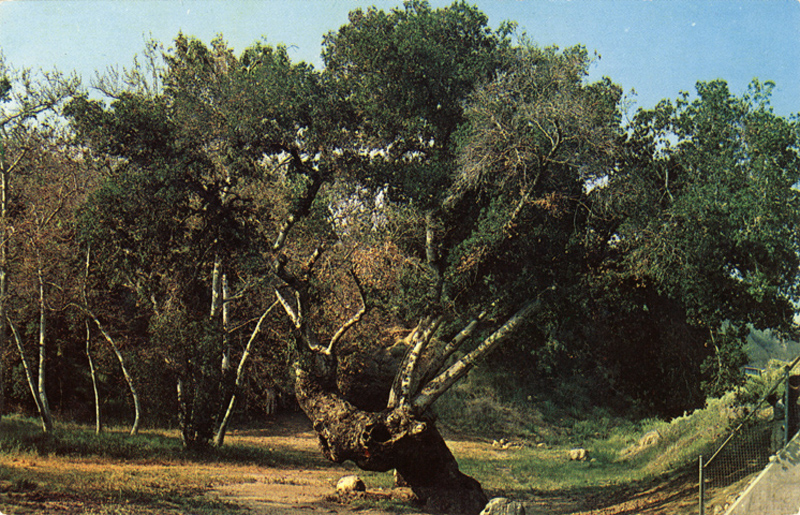
Perhaps you have been to Sutter's Fort where gold was picked out of a stream by James Marshall in 1848, an decisive event that remade our nation.  That discovery of gold in California is known by school children everywhere.  Well guess what.  Gold was first discovered in the Golden State in 1842.  In Newhall California.  Truth and legend say Francisco Lopez, a rider on the Spanish Rancho San Francisco (not to be confused with the city of SF) found gold flakes under an oak tree when he got off his horse to rest.  A mini-gold rush ensued that has been left out of the history books.  We local kids loved climbing in that oak tree--the Oak of the Golden Dream--which was polished smooth by generations of children who were fully aware of its significance.
 

Western America's first commercially successful oil well, No. 4, was drilled in 1876 in Pico Canyon, a few miles west of my house in a spot since called Mentryville.  The amount of oil brought out of the area was huge, and Well No. 4 was not closed down until 1990 after 114 years in business.  The Pioneer Oil Refinery, also a successful venture, was located a few miles across town.
 
"Pico Canyon Well No. 4" 
by Carleton E. Watkins (per Santa Clarita Valley history site http://www.scvhistory.com/scvhistory/ch1000.htm ) - Los Angeles Public Library http://catalog1.lapl.org/cgi-bin/cw_cgi?fullRecord+8510+968+46690+2+0.

 
 Pioneer Oil Refinery on Pine Street, about 2014
 
In the 1920s St. Francis Dam was built in San Francisquito Canyon, about 10 miles from my house, as part of a water project to slake the thirst of Los Angeles.  In 1928 the dam burst and millions of gallons of water swept 400 people to their deaths.  It was the largest man-made disaster in California history and ruined the career of the brilliant engineer, William Mulholland.  [photos are displayed on the links to previous posts]

 Tiburcio Vasquez (1835-1875) was a notorious rustler and bandit who terrorized and murdered storekeepers, ranchers and travelers all over the state.  He hid out in an area of convoluted rock formations, now called Vasquez Rocks, in the northeastern section of our valley.  It has long been a fascinating and favorite place for locals to hike and climb, and a movie set for Westerns and science-fiction films (John Wayne and Star Trek!).
Tiburcio Vasquez.png 
bad guy Tiburcio Vasquez

Beale Cut was a passage cleaved through a mountain on the southern end of Newhall in 1868 by Chinese laborers under the direction of General Edward Beale.  Pre Beale Cut, the rugged road from Los Angeles to points north (mainly San Francisco) was treacherous and usually impossible to ascend without the use of a windlass.  Beale's slice through the mountain made wagon and stagecoach traffic safe and do-able and opened up a new era of commerce and communication.  This route had been pioneered a hundred years before by Catholic friars and military men. After 1868 merchants and the Butterfield Stage made regular use of it.  Modern Scouts and schoolchildren, hikers and travelers have marveled at this 19th century engineering feat, and have thrilled at the marine fossils exposed in the vertical walls of the cut.  Hmmm, I wish I knew what happened to my fossil collection.
Beale Cut, also called (erroneously) Fremont Pass


 [Part 2 on Tuesday]


Wednesday, November 26, 2014

The Chinese Graveyard

Ruiz Cemetery (aka Chinese Graveyard)

We teenagers growing up in a small community sometimes had to invent something to do. In the Santa Clarita Valley in the 60s and early 70s, there were no malls, (hardly any stores period), few restaurants, no miniature golf, roller rink or other recreational activities. There was the Plaza Theatre that we went to once in a  while.  At our small high school clubs and sports were limited, and if you were female, which I was (and still am), you were barred from sports anyway, except for a girls' club that met after school.  But if you were me and were terrible at sports, the choice of activities narrowed further.

Sometimes my friends and I would just walk around for something to do.  When we were old enough to drive and lucky enough to have a turn with the car, we would drive around for something to do. We explored Hart Ranch and remote wilderness roads.  I rode my friends' horses after school, or went to farm auctions with a particular friend.

The more daring among us bragged about going to Colored Sands Cave on weekend nights. I didn't know what they did once they got there, but we can be sure it wasn't looking at the stars.  Another place teens gushed about was the Chinese Graveyard.  Everyone talked about how scary it was and how gutsy you had to be to go there.  Even the upright Mormon kids talked about the mysteriously creepy haunted ghostly Chinese Graveyard.

So, when I worked the late shift at newly opened Magic Mountain, sometimes that's where a few of us would go. It was always after midnight when we got off work.  Out to San Francisquito Canyon we would drive. Back in the day this was almost the middle of nowhere. There were a few ranches on the narrow curvy road.  No lights. The graveyard perched on a hill on the west side of the river but we parked on the east side, because the cemetery was on private property, so we couldn't go cruising up the long rutted driveway in the middle of the night.

Once parked, we hiked across the broad shallow river bed, which was usually dry. We counted on there being moonlight enough to see.  I'm surprised we never stepped on any rattlesnakes. The graveyard was easy to spot even in the dark because the only trees in the vicinity grew among the headstones. We headed straight for the looming spectral pine and pepper trees.

I should comment on the name of this place. Why it was called the Chinese Graveyard, I have no idea.  There are no Chinese buried there. We heard that the graves were those of flood victims from the 1928 dam break upstream. The truth is, there are some victims buried here, and most of the graves are related to the Mexican Ruiz family.  6 of the Ruizs were wiped out that terrible day of the flood.  I only recently found out the place is rightfully called the Ruiz Cemetery.

Ruiz family, flood victims who died March 13, 1928

Even though the graveyard is on private property, we had no qualms about sneaking up there under cover of darkness.  I never participated in shenanigans such as hiding behind a tree to spook someone.  Or draping white sheets in the trees to frighten newbies.  I never saw a ghost up there or felt the frosty chill that kids believed signified the ghostly presence of a mournful flood victim.  It was a place of fascination and reverence to me, because every gravestone represented a life.  And every life has a story that intertwines with the history and landscape of a place.   Sometimes the stories are upbeat and lengthy. And at times they end prematurely, as with the Ruiz family which has lain here together for most of 90 years. Their holy terror probably lasted only a few moments as they heard the thunderous crashing and felt the rumble of the approaching water. It enveloped them and their terror was swiftly over.

The cemetery is now abutted by development. It is still on private property though. Even though my nocturnal visits there were illicit, I am glad to have spent some meaningful moments there so many years ago.

William S. Hart (kneeling in center) and his cowboy friends place a memorial marker in Ruiz Cemetery to the 1928 flood victims

closeup of the marker
photo by Leon Worden

NOTE: read here for more about William S. Hart

Tuesday, November 25, 2014

"I Envy the Dead"

To complete the saga of the gifted water-engineer William Mulholland. . .

In 1926 an additional water storage reservoir and electrical power facility in the Los Angeles system was added, the site chosen by Mulholland.  The new dam was christened the St. Francis Dam, and it was located in San Francisquito Canyon (near Saugus CA) not far from where I grew up.  Only, by then the dam had not been in existence for decades.  The St. Francis Dam had failed in 1928, a scant 2 years after its completion.  It was a catastrophe that has never been surpassed in California, in terms of number of lives lost in a man-made disaster.

the completed dam and filled reservoir

Multiple problems contributed to the failure of the dam, most importantly its placement against unstable rock and a fault line.  Water leakage occurred through cracks in the concrete.  Repeated inspections called for minor repairs but the experts were not alarmed by what they saw.  Pipes were installed to divert spillage from leaks in and around the concrete.

Downstream from the dam, farmers and powerhouse employees became concerned, then nervous, as anyone would, knowing 12 billion gallons of water was precariously perched not far above ones head.  On March 12, 1928 an additional leak was discovered by the dam keeper, Tony Harnischfeger.  He called for the experts and that afternoon William Mulholland and Harvey Van Norman arrived from Los Angeles for an inspection.  They found about 20 gallons per second rushing from the latest leak.  Yikes, I say.  They expressed that repairs could be done in the future.

But there would be no future.  Less than 12 hours later--at just about midnight--the dam failed.  Its collapse unleashed a torrent that few would escape that night.  A mile below the dam, Powerhouse #2 was wiped off the face of the earth, and along with it, nearly 70 people, all employees and their families.  Harnischfeger, the dam keeper, and his son Coder were never seen again.  Churning over farms and fields down the canyon, the towering, thundering deluge followed the Santa Clara River bed 54 miles west to the sea.  Along the way it drowned whole families, buckled railroad tracks, wiped out structures, agriculture, livestock, cars whose drivers were unfortunate to be on the road that night, and it carried away a work camp full of men sound asleep in tents on the riverbank (84 of them drowned).

fallen dam sections

The Tombstone
what remained of the dam (looking downstream from where the reservoir used to be)

Heros were abroad that terrible night.  A switchboard operator 40 miles downstream got the frightful news and stayed at her position until the last possible moment, phoning the alarm to families in the path of the water.  She also alerted the police.  Two motorcycle policemen traveled east with their sirens blaring, towards the oncoming water, to shout warnings to citizens they aroused from their beds. Hundreds of lives were saved.

Victims and debris were washed out to sea, and others were buried by deep layers of mud.  Over the years bodies attributed to this disaster were occasionally recovered, including one as recently as the 1990s.  About 450 bodies were recovered.  It is thought that about 500 were killed.

the disaster was news around the country; this is a New London CT newspaper, March 13 1928

Strange stories circulated after the disaster, and even when I was a teen in the late 60s.  About 5 people had separately passed the dam that night. Some heard eerie sounds--tumbling rocks and moving earth--others heard nothing.  The dam keeper's girlfriend's fully-clothed corpse was found wedged in concrete just below the dam.  How did she get there?   Was she on top of the dam when it collapsed?   Remember, the keeper and his son were never found.  Weeks before the collapse one downstream resident had taken to sleeping in his barn on high ground because he knew the dam was going to fail; that night he heard the thunder of the water from his safe refuge.  Other folks expressed premonitions of disaster.  One woman rode the flood down the canyon on a board from her demolished house.  There is the mystery of a ladder found wedged in a portion of the dam.  Survivors were found in the tops of trees.  Supposedly one survivor was found stuck in muck up to his neck.  Weird.  The dead were dug from the mud over a period of many years.  Tomorrow I'll write about the haunted graveyard of some of the victims.

What about William Mulholland, the creator and engineer of this major disaster?   How did he react to the shock and devastation?   Remember that connected to the dam was a power facility, which generated electricity for Los Angeles.  It is said that when the city went dark that night, everyone employed by the LA Department of Water and Power knew exactly what had just happened.  Including Mulholland.   He and others hurried to the dam site that night, reaching it 2 1/2 hours after the collapse.  I'm sure he desperately wished there was a way to turn back the clock a mere 12 hours.  He later said, "I envy the dead," and  "The only ones I envy about this whole thing are the ones who are dead."
Mulholland and Harvey Van Norman at the tragic site, March 15 1928

During the subsequent investigation, Mulholland eventually took the blame; that could not be avoided.  "Fasten it on me.  If there is an error of human judgement, I am the human."  You've got to give him credit for manning up to his drastic error.  In the aftermath of the flood, a sign popped up urging "Kill Mulholland."  That was hardly necessary; he probably died inside a hundred times, or maybe 500, once for each of the dead.  He resigned his position, crushed and disgraced, and died 7 years later, his brilliant career in ashes.  Mulholland's charmed career made it possible for Los Angeles to become what it is.  It ended horribly tarnished by failure and death.


concrete debris at the dam site today


Saturday, November 15, 2014

William S. Hart's Horseshoe Ranch


William S. Hart

In 1946 a well-known silent film star, veteran of scores of Western movies, passed away on his ranch in Newhall, California.  HIs name was William S. Hart, star of early pictures such as Ben-Hur (1907), The Gunfighter (1917), and Tumbleweeds (1925).   He counted among his friends Tom Mix, Maurice Chevalier, Charles M. Russell, Frederick Remington, and other celebrities.  He knew Bat Masterson, Wyatt Earp and Will Rogers.  From Newburgh, NY, he had begun his acting career on the stage in New York City in 1888.  About 1913 he headed west to act in Westerns, met a pinto named Fritz on a set, and became known for films that portrayed the West as it was: rustic and rugged, harsh, dusty, full of really really bad folks, some good folks too, and a place of boundless sweeping vistas.

Hart on his beloved horse, Fritz

About 1921 Hart bought land in the foothills of the Santa Susanna range on the south end of Newhall, and named it Horseshoe Ranch.  He built a Spanish-style hacienda he christened La Loma de Los Vientos, a bunkhouse, stables, and other outbuildings, and put in a swimming pool surrounded by a sunny plaza.  Hart collected guns, including several that had belonged to Billy the Kid.  He loved Western art and acquired some Remington and Russell originals, and Navaho rugs and artifacts.

La Loma de Los Vientos

Before his death Hart did something so magnanimous, so brilliant and far-sighted.  In his will he left Horseshoe Ranch to the people of Los Angeles County with the stipulation that it be open to the public for free.  Yeah.  And his slice of heaven on earth became my family's slice of heaven on earth, a favorite destination from about 1959 on.  We picnicked here, we hiked the acres of oak-dotted hills, tarried at the corrals, collected peacock feathers, looked for the hoot owl that lived in the shack.  We relished the Charley Russell art, the Remington sculptures, the antique guns and thrilled at the grizzly bear rug in the upstairs living-room.  From the pleasant terrace we gawked at craggy chaparral-covered ridges, the buffalo herd down the ridge, and the panorama of the Tehachapi Mountain Range miles to the north.  I have spent a heap of happy hours at Hart's ranch.

entrance to the ranch

foyer and staircase

Hart's living room

Hart's gift gratified the local community.  The first high school in the Santa Clarita Valley was close to opening at the time of his death, and it was decided to name it William S. Hart Union High School.  And that's my alma mater, class of 1972.  I don't know if there are other schools named after movie actors--that can be a roiling pit of quicksand, given reputations common in that occupation.  Not that Hart was perfect, but he had been a good neighbor and community contributor for decades before his death.  [NOTE: read here for another kind action by Hart]

Hart must be smiling down from above at the joy four generations have experienced at his ranch.  His reason for giving his estate to the public, was simply this:


"When I was making pictures, the people gave me their nickels, dimes, and quarters. When I am gone, I want them to have my home." -- William S. Hart

Friday, November 8, 2013

A Horrible Crime in My Childhood Neighborhood


me on the front lawn of our brand new house, 1968

I don't make a habit of living in sketchy high-crime neighborhoods. Yet twice in my life I have lived just around the corner from a scene of triple-murder. Yeah. The first of them was random--that was mighty scary. The second was a family deliberately targeted, so we had no fear for our personal selves that day. Both times the murders occurred in orderly nice neighborhoods full of children and families and people who went to work every day.

I wrote about the second murder here, here, and here. And now the first:

This one occurred on November 29, 1972 during my freshman year of college when I attended nearby College of the Canyons in Valencia California. My family lived in a planned community with a variety of homes among parks, a shopping area, and a clubhouse with pool and tennis courts, all of which were within walking distance on paseos (very wide curvy sidewalks that were not cut by streets).

The day of the murder I finished my morning classes about 10:50 a.m. My friend Emily was riding with me in my Mom's forest green Dodge Dart sedan, which I had borrowed for the day. We drove down Rotella St. near our houses at 11:10. I vividly remember looking at the clock. After dropping Emily I went home to my empty house through the unlocked front door--we never locked our doors during daytime.

I hadn't been home but 5 or 10 minutes when my Mom called from her work at Sierra Vista Junior High out in Saugus. She was frantic, and instructed me to lock the doors and stay inside until I heard from her again. There had been a murder in the neighborhood and the suspect was at large. Yikes.

That morning Mrs. G, who lived on Rotella, had invited a neighbor's son to play with her 3-year-old son. She and the 2 boys were out on her driveway when a young Black man--Robert Grigsby, age 17--pursued them into her house, grabbed a knife from Mrs. G's kitchen, chased the three into the back bedroom and slew them all. About that time Mrs. K, mother of the other boy, came down to find out why Mrs. G was not answering her phone, and walked in on the murder scene. Mrs. K was slashed by Grigsby, who then took off.
from my 1972 high school yearbook

The police were called and then the word swept to every corner of the Santa Clarita Valley. As mentioned above, I drove past Mrs. G's house on Rotella at 11:10, the exact time later determined that the murders occurred. I probably got home at 11:15, and by 11:25 my Mom was calling me from her work eight miles away to tell me of the murders. The word of the crime spread that fast. Our area was still partly rural, not heavily populated, and it seemed we knew everyone else, or at least knew of them, so one phone call became 10, and 10 became a hundred, and so on.

My friend Emily also got a call from her Mom. Emily called me to say she was too afraid to stay home alone and wanted to run to my house. I implored her to stay home with the doors locked but she was willing to risk being out and about with a murderer on the loose, rather than be home alone. She made it over. I recall that by noon, less than an hour since the murder, Mom called to say the perp had been caught down by the river, a few blocks north of our house.

The perp was, is, mentally ill and had exhibited alarming aggressive behavior previously. His brother was well-known at my high school, but I had not known this kid--perhaps he wasn't a regular attender. There's plenty of unanswered questions about that dreadful day, and virtually zero about it on the internet. I don't even know if he's still incarcerated but can hope that he never sees the light of day.

It has always creeped me out that our house was unlocked. If Grigsby had walked a few more blocks and seen me go into my house, he could have come in after me. Or he might have been waiting for me inside . . . I did not know the victims personally, yet will always remember them as innocents whose paths tragically crossed with a psychopath. 


Saturday, November 24, 2012

Antique Postcards

A few years ago I began buying up old postcards of places that were important to my family and our history. We have few photographs of our ancestors, so the next best thing to pictures of our people is a picture of the places they lived, worked, and worshipped. Companies created postcards of the most average mundane scenes, which is a bonus for people like me who buy them for family reasons. I don't need a postcard of the Golden Gate Bridge, for instance, because it doesn't have significance to my family. But a postcard of a the coke ovens in Star Junction, Pennsylvania? I'll pay bucks for that one!

Ebay is ideal for this. There's many for sale and if you wait long enough, a postcard of the exact place you want will pop up. Some examples:

Powers Institute, aka Bernardston Academy, is where my great-grandfather Michael Henry Toomey attended high school circa 1876. It still stands, now as a museum. The photo is probably from the early 1900s.


 A view of South Vernon, a railroad junction that straddles the state line of Massachusetts and Vermont. The building on the left is the old hotel, which is still there, and was new when my Toomeys lived in South Vernon in the 1870s and 80s. This quaint view has been altered by a modern a highway.


The dangerous intersection of three bridges north of Brattleboro, Vermont, late 1800s. The writing on the bridge says "Walk Your Horses." This junction was modified after some terrible accidents between trains and horses. My Toomey and Sullivan ancestors would have passed through here once in a while.


The Brooks Free Library, Brattleboro VT in 1910. It was built in the 1880s when some of my family would have borrowed books (I hope). What a pretty picture of the first real library in town. It has long since been replaced by a modern, but less attractive library.


A public school close to my Grandma's house in Brooklyn, NY. She lived on the corner of 4th Ave. and 78th, so this may have been where she attended. If not this one, then one a lot like it.


Even photographs of events such as parades and fairs were sold as postcards. This one of the local county fair in Brattleboro, called Valley Fair, I believe was taken pre-1910. Fairs, lectures, church socials, traveling circuses, and post-Civil War GAR events were our ancestor's entertainment, and you can find postcards of just about all of those events.


My Mom grew up in Washington Heights on Manhattan, not far from this library, immortalized in a postcard circa 1900.


The Dellbrook House in Perryopolis, PA, circa 1950, built by my step-mom Hazel's then-husband in 1948. In 1996 Dad married Hazel and moved into this house. In 2001 the stairs became too much, so they sold it to my brother who lived there until 2007 ish. This postcard is entitled Modern Perryopolis, the Carl Dellbrook House and is still sold in the local drugstore.

Monessen PA's Greek Catholic Church, which my grandparents attended about 1918-1921. Nice that someone thought to make a postcard of it.


This postcard pertains directly to my life. Beale Cut, aka Fremont Pass, aka San Fernando Pass or Newhall Pass, near Newhall, CA. When I was growing up it was a major thrill to climb down into this cut which was made for the Butterfield Stagecoach Line, about 1863. This was the original road from Los Angeles to San Francisco. On the other side of this cut was the local oil refinery. I remember the thrill of finding shell fossils in the side of the cut. It is badly eroded now. And it is seen in plenty of old western movies.