Showing posts with label History. Show all posts

Saturday, July 20, 2019

No Green Cheese in Sight!


I can't let this day go by without mentioning the moon landing, the greatest single event of my childhood. What a vivid memory I have of sitting in front a color TV in the living room of our close friends, the Price family of North Hollywood CA, and watching together both the landing and the first walk on the moon. I was 14 years old and it was my father's 48th birthday, July 20 1969.

The room was full of mile-wide smiles, hearts thumping in chests, and tears in eyes. We marveled at the stupendous accomplishment by the American space program. For all we knew, the moon was made of green cheese. During my childhood this was a common phrase, not that people believed it, but it was symbolic of the mystery of Earth's moon, and outer space in general.

When I was six or seven, my father told me that men would land on the moon when I was 14. The event occurred as he said, and I marveled at his prescience. Some years later I learned of President Kennedy's speech declaring that a moon landing would occur before the decade ended, and then I knew how Dad got so smart. My growing years were punctuated with the thrill of rockets defying gravity, space ships escaping earth's orbit, and brave men gladly enduring discomfort and even misery, while knowing they might not return. I still get teary watching a film of an Apollo rocket lifting from the launch pad awash in a blast of fire and smoke.

We have watched Apollo 11 several times this month, along with a documentary detailing the race to the moon. And it was a race, a space race, a war of ideology. America won, yes, but in actuality, humanity won. The accomplishment was a source of wonder and pride for individuals in every country, and indeed, a large portion of the Earth's population viewed the landing live. Huge TV screens were set up in metropolises around the world where fascinated crowds gathered to participate in an event that seemed impossible even a year before. Armstrong expressed it perfectly, "That's one small step for man, one giant leap for mankind," the first words ever uttered from the surface of the moon.

Early this morning our newest grandson was born, and several of us helpfully suggested names for him: Apollo, Buzz, Neil Armstrong, and other lunar-related names. The parents won't take us up on those suggestions, of course. In the future we can tell this little guy where we were and what we were doing exactly 50 years before he came to the Earth.


This is a short video showing the highlights of mid-July 1969

This one is a narration by Walter Cronkite about the moon landing

Monday, November 14, 2016

The Crystal Ball of History

Working backwards in time is the method by which family history is done.  The beginning of a life can be discovered only when the end is revealed.  The sunset of a life story is known before the dawn.  Terrible events and unpleasant endings to life are common; if only a researcher could travel back to an earlier time to warn the now dead, or even prevent the dangerous and harmful events that occurred in their lives.  Of course it can't be done.

Cornelius Flanagan
Cornelius Flannigan grew up in Brattleboro Vermont of Irish parentage.  In his 70th year he lived alone on a small island in the middle of the Connecticut River.  The island was connected to both the Vermont and New Hampshire shores by the Hinsdale Bridge, which was anchored halfway across at the island.  In the late winter of 1920 ice clogged the river, imperiling the stability of the bridge.

Cornelius spent a day in town, then headed home late that March evening.  A sheriff deputy saw him heading toward the bridge and home and warned him not to cross the bridge as it was being inched away from it's mooring by pressure from the ice.  At the bridge another sheriff announced the span would probably fail soon, and he must not cross.  Cornelius inspected the mooring carefully, then proceeded ahead.  Halfway across the unstable planks he changed his mind.  He ran back toward the shore as the bridge began to heave.  He never made it, and was carried to his death on the wrecked span under the surging ice jam.

After reading this in a 1920 newspaper, I found Cornelius on four or five census records beginning when he was a child of eleven.  I visualized his happy disposition and cherished spot as the only son in his family.  But I had already discovered his unpleasant, icy end, and in my mind the words, "don't cross that bridge!" jumped out of my brain.  I was as a gypsy fortune teller looking at his name on the page, able to predict his frozen demise.
Ice jam on the Winooski River, similar to the ice jam on the Connecticut River in 1920


Maurice Ferriter and Michael Griffin
Maurice Ferriter and Michael Griffin were two of scores of Irish children growing up in 1870 Brattleboro.  Irish parents did not have the luxury of showering attention on their children, so they were left to roam--the original 'free-range' children in today's parlance.  Fathers worked excessive hours on the railroad, in the slate quarry, or in one of the organ, chair, or peg factories clustered near the confluence of the Whetstone Brook and Connecticut River.  Mothers toiled ceaselessly to feed their families, launder, maintain their humble homes, and do piecework for the wealthier folks who lived uptown.

On a fall day in 1870 Maurice and Michael were part of a group of children out roaming the Irish patch (neighborhood).  In one of their homes Michael spied a rifle leaning upright in a corner of the room.  He picked it up and in jest, pointed it at Maurice and pretended to shoot.  The gun went off and where a rambunctious Maurice had stood was his heaped, bloody, whitening corpse.

Michael ran in panic from the horror and was found late that day hiding in the woods.  He couldn't be blamed for his impulsive, childish act, yet he was never right again.  Just weeks later he was killed in the train yard by a moving locomotive.

It's eerie then to discover this terrible accident, and then moving back in time, to see these two carefree boys enumerated with their families on the 1870 Census, and then to find their birth information.  In my mind's eye I could see them toddling around the kitchen, attending the town school, and enjoying the liberty granted to children back in the day.

These are two of countless instances of a warped kind of prescience that dogs me and other family historians when we dive into the records of the past. 

The train yard where Michael met his end.  Photo is later, circa 1900; gas house is on the left, depot in center.  Michael and Maurice lived in the distance (past the depot) to the right of the tracks.


Monday, November 7, 2016

The Strange Disposition of Willie Keel

 the resting place of Willie Keil in Cowlitz County, Washington

Poor Willie Keil.  He so wanted to find "the promised land," and live out his life as a faithful man, raise a family, till the earth.   He did live out his life faithfully, but never got to have a family, and the only earth he "tilled" was that of his own grave.  We can assume he found his promised land on the "other side."

Willie was born in Missouri about 1836 to a father who was leader of a religious sect.  The Bethelites, as they were called, decided to head West in 1855 in search of their own personal promised land.  Practically on the even of departure Willie contracted malaria.  He insisted on a promise from his father to not leave him behind, no matter what happened.

Willie's father kept his promise.  On Willie's death a special coffin was built to transport him to the promised land with the rest of the Bethelites.  The coffin was lined with lead and Willie was laid inside.  Jugs and jugs of whiskey were poured into the box until Willie was immersed in alcohol.  The lid was nailed on, the coffin loaded onto a hefty wagon, and the party headed west with the young man saturated in 100 proof.

 Six months later the party arrived on the Washington Coast and Willie was interred.  Sadly, the gloomy sodden land was not what the pioneer group was looking for.  They packed up and moved south to Oregon, leaving Willie's stone-marked grave behind.  The colony they founded in Aurora is in a lovely fertile place where even now, hops and berries and flowers are commercially cultivated.  Schoolchildren take field trips to Aurora and are told the curious tale of Willie Keil.


Source: http://www.historylink.org/File/5453

Tuesday, November 10, 2015

Newhall California (Part 2)

 The Film Industry

One of Newhall's marvelous claims to fame is the movie ranches scattered around the area.  A few have disappeared and others such as Disney's Golden Oak Ranch (Old Yeller, Roots, Pirates of the Caribbean) are still going strong in Placerita Canyon. 
 a set at Golden Oak Ranch

As a child I watched and loved black and white Western movies that were shown on Saturday afternoons.  In Westerns, the scenery should be listed in the cast of characters because of the strategic role it always played in shaping the on-screen drama.  I came to recognize places around the area that I had seen in these old movies, places such as Santa Susanna Pass or sites in the Newhall or San Fernando Valley area.  Even the movie sets, though altered for each film, had a sameness about them. 
 Three Monogram cowboys ride tall in the latest volume of Warner ...
a Monogram movie poster

I believe Monogram and Republic were the first movie ranches around Newhall.  Republic was located where Golden Oak Ranch is now, and Monogram produced many hundreds of Westerns over a 50-year period (Gunsmoke, High Noon, The Virginian) before selling out to Gene Autry, the singing cowboy, in 1962.  He renamed it Melody Ranch and from there put on a popular TV program of Western music.  Still called Melody Ranch, it still hosts film production. 

Randall Ranch was an equipment supplier to the movie business and was located over on Pine Street near the Pioneer Oil Refinery mentioned in yesterday's post.  Randall's had the props and equipment that films needed during production: stagecoaches and wagons, horses and buffalo, guns, Indian props, etc.  My sisters used to go over there and ride around on one of the buffalo.  Yeah. 

An early movie actor named Hoot Gibson owned a ranch near the river that evolved into major rodeo grounds.  In the 50s it transitioned into Saugus Speedway and on still evenings we could hear the noise of the cars racing around the oval.  The place was later bought by my friend's parents and became the site of our almost death on the railroad tracks.

William S. Hart, another early Western actor, worked and lived in Newhall.

And a famous family of Hollywood stuntmen lived nearby--Yakima Canutt and his sons.  Yakima doubled for John Wayne and choreographed the wild chariot race in Ben Hur
Yakima Canutt

The Newhall Incident
What is probably the most tragic event ever to occur in my hometown, I have written about here.

Magic Mountain
There weren't enough teenage-level jobs to go around in the Newhall area until Magic Mountain (now Six Flags) was completed in 1971.  Previous posts cover Magic Mountain here and here.  It is still a very popular destination and is known for its crazy roller coasters.  I will say it was the most fun place I ever worked!

I am so lucky to have grown up in a place abounding with fascinating history, stunning landscape, and a rural wildness that has regretfully disappeared in the decades since my teen years. 


Monday, November 9, 2015

Newhall California (Part 1)

 
  Los Angeles Public Library, Valley Times Collection

Folks have a special place in their hearts for their hometown.  Fond memories and sweet nostalgia grow in proportion to the amount of time spent away.  Hometowns become the baseline or standard for other places we live, even as we realize that the distance of time and space have created a place in our minds that may not be reality.  Even so, most of us are cultured enough to refrain from boorishly reminding others that "in [insert hometown name] we did things this way, or that way" implying that it was better.  Maybe it was, maybe it wasn't.

But MY hometown . . . MY hometown is truly a special and unique place, and not because of the quaint memories stored in my own brain.  After all, I lived there only during my teenage years, and it has been over 40 years since I actually called it home.

No, my hometown of Newhall-Saugus-Valencia California (now renamed Santa Clarita) is special because of momentous events, historical and innovative, that have occurred there.  Most of these may be unknown to you, but in Southern California the area's rich history is well-known and is an important part of the state's past.

I'll start with an invention everyone will recognize.  You know those baby carrots you buy in the bags in the produce section?   Yup, developed in Newhall California by Mike Yurosek.  He grew Bunny Luv carrots a few miles from my house.  Mike was disturbed by the waste of "deformed" carrots that were too disfigured to be packaged into the pound bags sold in the grocery, so he refined them into these little nubs of carrots, and the rest is history.
 

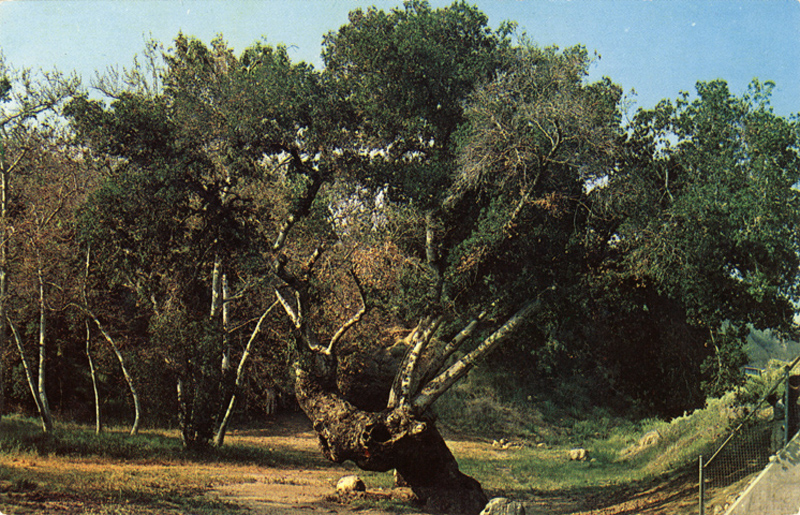
Perhaps you have been to Sutter's Fort where gold was picked out of a stream by James Marshall in 1848, an decisive event that remade our nation.  That discovery of gold in California is known by school children everywhere.  Well guess what.  Gold was first discovered in the Golden State in 1842.  In Newhall California.  Truth and legend say Francisco Lopez, a rider on the Spanish Rancho San Francisco (not to be confused with the city of SF) found gold flakes under an oak tree when he got off his horse to rest.  A mini-gold rush ensued that has been left out of the history books.  We local kids loved climbing in that oak tree--the Oak of the Golden Dream--which was polished smooth by generations of children who were fully aware of its significance.
 

Western America's first commercially successful oil well, No. 4, was drilled in 1876 in Pico Canyon, a few miles west of my house in a spot since called Mentryville.  The amount of oil brought out of the area was huge, and Well No. 4 was not closed down until 1990 after 114 years in business.  The Pioneer Oil Refinery, also a successful venture, was located a few miles across town.
 
"Pico Canyon Well No. 4" 
by Carleton E. Watkins (per Santa Clarita Valley history site http://www.scvhistory.com/scvhistory/ch1000.htm ) - Los Angeles Public Library http://catalog1.lapl.org/cgi-bin/cw_cgi?fullRecord+8510+968+46690+2+0.

 
 Pioneer Oil Refinery on Pine Street, about 2014
 
In the 1920s St. Francis Dam was built in San Francisquito Canyon, about 10 miles from my house, as part of a water project to slake the thirst of Los Angeles.  In 1928 the dam burst and millions of gallons of water swept 400 people to their deaths.  It was the largest man-made disaster in California history and ruined the career of the brilliant engineer, William Mulholland.  [photos are displayed on the links to previous posts]

 Tiburcio Vasquez (1835-1875) was a notorious rustler and bandit who terrorized and murdered storekeepers, ranchers and travelers all over the state.  He hid out in an area of convoluted rock formations, now called Vasquez Rocks, in the northeastern section of our valley.  It has long been a fascinating and favorite place for locals to hike and climb, and a movie set for Westerns and science-fiction films (John Wayne and Star Trek!).
Tiburcio Vasquez.png 
bad guy Tiburcio Vasquez

Beale Cut was a passage cleaved through a mountain on the southern end of Newhall in 1868 by Chinese laborers under the direction of General Edward Beale.  Pre Beale Cut, the rugged road from Los Angeles to points north (mainly San Francisco) was treacherous and usually impossible to ascend without the use of a windlass.  Beale's slice through the mountain made wagon and stagecoach traffic safe and do-able and opened up a new era of commerce and communication.  This route had been pioneered a hundred years before by Catholic friars and military men. After 1868 merchants and the Butterfield Stage made regular use of it.  Modern Scouts and schoolchildren, hikers and travelers have marveled at this 19th century engineering feat, and have thrilled at the marine fossils exposed in the vertical walls of the cut.  Hmmm, I wish I knew what happened to my fossil collection.
Beale Cut, also called (erroneously) Fremont Pass


 [Part 2 on Tuesday]


Monday, November 24, 2014

"There it is. Take it."

 William Mulholland, 1924

William Mulholland is memorialized in the name of the swanky, serpentine mountain road called Mulholland Drive that skirts the mountains north of downtown Los Angeles.  An Irishman, seaman, zanjero (ditch keeper), and brilliant self-taught engineer, he eventually rose to the position of superintendent of the Los Angeles Water Department.   When you know how important the management of water was in arid dusty burgeoning Los Angeles, you know that Mulholland rose to that post because he knew what he was doing.

Except when he didn't.  I'll get to that in tomorrow's post.

From the 1880s on, Los Angeles and the rest of Southern California was promoted to Easterners as a healthful agreeable place to settle, and the people came in droves.  They raised stock, cultivated farms, and before long the sweet aroma of tens of millions of lemon and orange blossoms wafted across the land.  The Mexican system of irrigation--ditches diverting the meager Los Angeles River--shortly became inadequate.

a Los Angeles-area scene, early 1900s; wouldn't you want to live here too?


Enter William Mulholland.  By 1887 he was in charge of water in Los Angeles.  Population boomed, growing from 50,000 in 1890 to 320,000 in 1910.  Los Angeles was and is a desert.  The Los Angeles River swelled only when rain or snow fell in the mountains.  Water would have to be brought in from somewhere else.  Somewhere else was the key to LA growth.  Somewhere else turned out to be the verdant, cultivated Owens Valley, 230 miles to the north.  Through a series of shady deceitful dealings by multiple people (including Mulholland), Owens Valley was drained of it's lake and river.  The water was channeled through a brand new massive aqueduct system to supply Los Angeles with liquid gold.  100 years later, that aqueduct is still imperative to the survival of that city.  A second system was added in 1970.

The terminus of the aqueduct was called the Cascades.  The pipe came from the north through a mountain at the northern most point of Los Angeles, and spilled through flood gates to the south.  Water, this expensive purloined water, tumbled down a channel into San Fernando Reservoir, a series of lakes that cradled the liquid gold Los Angeles craved.

a portion of the Los Angeles Aqueduct under construction, 1913

I grew up in the shadow of the aqueduct.  I have passed the Cascades thousands of times.  I have seen the barren Owens Valley.  I have tried to visualize it as it once was: a place of verdant growth and abundant agriculture before Los Angeles got hold of it.  Hardly a year in the last hundred has passed without some aspect of Los Angeles's water-related transgressions tied up in the courts.

On November 5, 1913, a triumphant Mulholland stood at the steel wheel that would release the water taken from the few, for the benefit of many.  As he turned the wheel, Mulholland said, "There it is.  Take it."   And it was done.  Los Angeles got what it wanted, thanks to William Mulholland.

the first drops of Owens Valley water arrive at the Cascades to slake thirst in Los Angeles, November 5, 1913


November 5, 1913: opening day at the Cascades, the southern terminus of the Los Angeles Aqueduct; Owens Valley water filled San Fernando Reservoir (not shown in photo), supplying LA with the water that further fueled its growth
(an interesting side note: Interstate 5 now runs horizontally where the long crowd of people is standing)


TOMORROW: "I Envy the Dead"

Sunday, November 16, 2014

My Trump Card

Joshua Trees are thick in the Mojave

In the mid-1970s our family lived in the Mojave Desert while Craig worked as an engineer on top-secret military projects at Naval Weapons Center. I did a lot of reading during those years about that lonely, wild, and breathtakingly beautiful part of California.

Besides being the historic home of tribes of Mojave Indians who had all but disappeared, early explorers had passed through the desert and nearby Sierra Nevada Mountains. Rich veins of ore were discovered, giving the rugged area a legendary mining heritage--gold, silver, lead, zinc, borax, and other valuable deposits came out of the Mojave and surrounding mountains. In my extensive reading I became familiar with mine locations and major players in the industry in the 19th century. Cerro Gordo was the big daddy of mining operations in the Sierra Nevada.

Fast forward 25 years to the 1990s. My sister Alice and I spent a few spring vacations camping in the wilderness of Death Valley. We drove for miles off-road, set up camp, cooked over our fire, endured violent "banshee" windstorms, hiked, and enjoyed the dramatic scenery. Those trip are among my favorite memories ever.

our Echo Canyon campsite in Death Valley

This one spring we stayed a night in Lone Pine, a town near Death Valley, the first night of our camping trip. I don't remember why we didn't camp out, but we might have gotten up near Death Valley too late in the day to find a place to set up for the night. Anyway, we grabbed some dinner at a small diner, and got to talking to the folks at the next table. We mentioned to one fellow that we were interested in seeing the old mining town of Cerro Gordo. He said the settlement was now privately owned, but that he --Tom--  was close friends with the owner --Dee-- and that it was ok if we drove around the road barrier she had set up to keep looky-loos out. When we got up there we should tell her that Tom gave us permission.

The next day we did it. Drove out to the foothills, drove around the road barrier, and the SUV crawled up the steep, windy dirt road to the old mining camp high in the mountains. As we pulled into Cerro Gordo a woman, who turned out to be Dee, flew out of one of the old houses demanding to know what we were doing there--didn't we see the barrier down below? We blamed our presence on Tom. Dee exclaimed she was preparing for weekend guests and didn't have time to have tourists around. She saw a couple of our children in the car and decided she had a moment to give us a quick look at one of the old houses and off we went.

the mining boss's house

In the front room of the house Dee related a nutshell history of the Cerro Gordo Mines. I glanced around and saw a man's photo hanging on the wall. When she paused I blurted out, "Hey, that's Mortimer Belshaw!" She was struck dumb for a few moments. Mortimer Belshaw was the man who made Cerro Gordo profitable (and himself wealthy) by figuring out a way to get Cerro Gordo silver hundreds of miles south to Los Angeles. Well, remember the extensive reading I referred to above? Belshaw was a star player in Mojave-area history, and I had not forgotten him. I had played my trump card, I had passed GO and collected my $200. And I'm really glad he had an outstanding name that was easy to recall.


Mortimer Belshaw

Well, a startled and amazed Dee thawed out right there in front of Belshaw's photo; I had apparently been the first person ever to recognize the man. She gave us a tour of the rest of the house, and then declared we could take our time looking around the town as long as we stayed away from the mine shafts. We lingered, explored, and even bought a couple of local history paperbacks in the dusty cluttered museum. On the way down the mountain the SUV had trouble; even in low gear and with Alice's foot firmly on the brake, it was hard to control speed--the road was that steep. Poor Alice had to buy a new transmission after that trip, but it was worth it to have a once-in-a-lifetime trip to remote, secluded Cerro Gordo.


Tuesday, November 11, 2014

Luke Ferriter, Civil War Veteran

In honor of Veterans' Day, let's go back in time to the Civil War.  Irish immigrants made an important contribution to both armies, Union and Confederate.  Below is a life sketch of one of those men.  His name was Luke Ferriter, and he ran away from home to join the Union Army at age 16.


from the Brattleboro Reformer Newspaper about 1916

Luke lived a life of adventure tinged with sorrow.  His early years were spent in Ireland without his parents.  They had left the Emerald Isle during the Famine years to find work and he joined them in Vermont when he was 12 (about 1857).  To get to the US he endured a shipwreck, losing what little he owned, and on arriving in New York was dismayed to find that no one knew his parents.  Perhaps that's to be expected from a naive native of a tiny Irish hamlet who was used to everyone being acquainted with everyone else.  This 12-year-old boy made his way to Massachusetts where he discovered his parents had moved to Brattleboro Vermont some years before.

When war broke out in 1861, Luke's father forbid him to join up.  Luke ran off to Springfield Vermont and signed up under the name Charles Smith.  When the train full of recruits passed south through Brattleboro, Luke hid in the lavatory while his father searched the train for the rascal.

Over the following four years young Ferriter participated in plenty of action.  Many times he heard bullets whiz close to his head, or saw them plow into the ground at his feet.  A piece of shell shattered his gun giving him a neck wound.  At The Wilderness bullets ripped through his clothes without leaving a scratch.  A thigh wound occurred at Spotsylvania that was severe enough to send him back to Brattleboro for a stay in the military hospital.  I've wondered if either of his future wives helped nurse him back to health there.  Luke gained local fame for capturing an officer of a South Carolina outfit, and later a member of the Confederate rear guard.  

After the war Luke married Ellen Martin who was also an Irish immigrant.  As members of Brattleboro's closely knit Irish Catholic community, they would have known one another in their teens.  Ellen died delivering her third child in 1871.  A second marriage, to Eliza Anne Fenton in 1873, lasted 53 years.  Those two also knew each other as teenage Irish immigrants.  Four of their children died very young, and a son Andrew, died at age 18 when he tumbled out of the loft of the local livery stable.  What a crushing blow.  Five children survived to adulthood.

Luke Ferriter's granddaughter, Catherine Ferriter Rogers, told me that he preserved his Civil War uniform, and enjoyed regular invitations to local classrooms to talk to students about the war.  He must have enjoyed dressing the part of a soldier once again, and reliving the excitement and danger of battle, and of his notable exploits.  That uniform is now owned by some of his descendants in Rhode Island.

In Luke's later life he wore many hats.  He worked as a factory fireman, on the railroad, as a cigar maker, and for a shoe manufacturing company.  He was active as a volunteer fireman, led the local post of the Grand Army of the Republic (the Civil War Veterans organization) and he worked for temperance among the Catholics of Brattleboro.  Later on Luke and his wife took care of an elderly single Irish woman for several years until her death.

81-year-old Luke Ferriter (on right) discusses his Civil War experience with a writer
(from the Boston Herald Newspaper via http://irishamericancivilwar.com)

I admire and appreciate men like Luke Ferriter who threw themselves full bore into harms way.  They had much to lose.  Ferriter was one of the lucky ones who returned home in full health, and lived a long life supporting his family and contributing to the community.


Sunday, November 9, 2014

November 9, 1989

The Berlin Wall, 1960s

I have written about the fall of the Berlin Wall, one of the marvelous events of our time, previously.

It is 25 years since the day the world changed. The gates in the Berlin wall opened, shocking the world, and for the first time in 28 years East Germans could exit to the West without danger of being shot by East German border guards. West Germans welcomed them, hugging the bewildered East Germans and pressing money into their hands.

November 1989

In 1987 President Ronald Reagan had called upon Soviet leader Mikhail Gorbachev to show that he was serious about being progressive and open, as he had claimed he intended to be. And the act that would show his sincerity, would be the opening of the Berlin Wall, which had imprisoned East Germans for 28 years.

A portion of Ronald Reagan's bold, powerful, and thrilling 1987 speech in front of the Brandenburg Gate is found here. The speech and its aftermath are among the great moments of our time.


Today.  The row of lights represent where the wall once stood in front of the Brandenburg Gate.


On a related note:
This article is about Dieter Uchtdorf's escape from East Germany as a young child.

Wednesday, November 5, 2014

Portland's Bridges

Portland Oregon is a busy river city spanned by many bridges.  They cross the Willamette River through downtown and a little beyond.   Some are stunningly beautiful, others not so much.  A few carry interstate freeways.  The rest are local, and the newest one carries NO CARS!

Spanning the Willamette, beginning at the north end:

The Gothic-style St. John's Bridge is the loveliest of them all.   Opened in 1931, it links the community of St. John's with the West Hills.   I love the east bridge approach that winds through the neighborhoods; you earn the right to drive across this bridge.


The Fremont Bridge, opened in 1973; it carries Interstate 405.  This one is the grandest and most fun to drive on.  It's huge, it's majestic, and you feel like you're in space, looking down at the city.  Locally  it is known as the "flag bridge."


The Broadway Bridge, painted "Golden Gate red."   It was built in 1913, and opens vertically for tall river traffic.


The Steel Bridge carries bicycles, peds and railroad on the lower level, and cars and light-rail (MAX) on the upper.  A lift bridge, it opened 1912.


The Burnside Bridge is the most well-known and used in downtown and has been operating since 1926. Sometimes Burnside Street is used in a derogatory manner given the number of homeless and drunks who congregate in the area.  But for decades Saturday Market was held under the west end of the bridge, and that was a lot of fun.


Morrison Bridge.  Completed 1958.  This one swings open like the Burnside Bridge above.  You can see the two operator stations there on the deck.


The Hawthorne Bridge, which lifts, opened in 1910.  The red things are the 800,000 pound counterweights that lift the bridge.   It carries about 8000 cyclists a day in addition to road traffic.  At the end of the bridge is an electronic sign saying how many bikes have crossed that day.


Marquam Bridge built 1966 and carries Intersate 5.  Was there a design contest that called for the ugliest, most utilitarian structure imaginable, one without beauty, style, or class?   Actually yes.  It was designed by ODOT, and there was such an outcry about its design that public input was encouraged when the Fremont Bridge was in the planning stage (and what a difference!).  Sadly, this bridge is here to stay for a very long time.    


Tilikum Crossing.  The newest bridge on the Willamette, it's not open for business yet.  It has been interesting to see the building stages--it has been built from each side of the river, and the two parts met in the center a few months ago.  It is unique in that it will carry light rail, streetcar, buses, bikes and pedestrians.  NO CARS.  Completion 2015.


The Ross Island Bridge, built 1926.  This one has the craziest west bridge approach ever.  The first 10 years I lived here it was a white-knuckle sweaty experience learning my way on the approach. Signs are yelling at you "Turn here!!"   "Turn there!!"  "Get in this lane right now!!"  "Move to this other lane but only for 42 feet!!"  They should put up a sign that says, "Good luck folks."


The current Sellwood Bridge, the furthest south of the Portland-area bridges.  Notice it does not lift nor does it allow large ships underneath, because that kind of river traffic stops at the Port of Portland further upstream.  Built in 1925, it is being replaced as we speak by the bridge in the photo further down.  The two-lane bridge carries way too much traffic and has been in a deteriorating condition for 30 years or more.  And, it has a little 3-foot sidewalk for bikes and peds, which on a busy span like this, makes you feel like you're Nik Wallenda on a tightrope.
New:


The Interstate Bridge spans the Columbia River between Portland Oregon and Vancouver Washington.  I believe it is the ONLY lift-bridge left in whole United States that carries an Interstate Highway--I-5.  Beware of getting caught near here during a lift; it will add an hour to your trip.  A multi-state/multi-agency commission recently studied the issue of this bridge replacement.  The question was, what to replace this aging bridge with, what would be the cost, and who would pay?   The commission went down in flames because nobody could answer any of those questions.  So we're stuck.  Even if I live to be a hundred, that won't be long enough for my mortal eyes to behold a replacement bridge here.


Monday, August 18, 2014

The Fours

Corp of Discovery route

4:00 p.m., May 14 1804.  The most momentous undertaking in American exploration began at that very moment in St. Louis, Missouri.  The Corps of Discovery departed westward along the Missouri River, bound for the Pacific Ocean, charged by President Jefferson to explore and map the formerly French territory, engage in botany, zoology, geography, and establish trade with the current inhabitants.

The beginning of the Lewis and Clark Expedition is only one notable event that has occurred during a year ending in the number 4.

Two hundred years ago this month, America's first Executive Mansion in Washington D.C. was burned by the British on August 23 1814.  On the night of September 7 1814, Francis Scott Key wrote the poem that set to song, has become our distinguished, stirring National Anthem.  I have been twice to Fort McHenry where the Star Spangled Banner flew during the battle for Baltimore, and now comprehend the pivotal victory that occurred there against all odds.

Fort McHenry, 1814

1824--I could not think of anything significant about 1824 but when I googled it, what came up was the establishment of Fort Vancouver on the Columbia River by the Hudsons Bay Company.  The lovely, Lincoln-Loggy, spiky-timbered fort has been reconstructed as a National Historic Site.  I've spent numerous happy hours here where Indians and trappers once gathered to barter for food, blankets, furs, tools and the skills of the blacksmith.

Fort Vancouver, Washington

1834--same problem as the above.  On August 1, 1834 slavery was forever abolished in the British Empire.  Should have remembered that one; my senior thesis at BYU was about the demise of black slavery.

June 27 1844, a day of historic shame for the US of A.  Joseph Smith, founder of the Church of Jesus Christ of Latter-day Saints, was murdered by a mob in Carthage Illnois.  Yes, that happened in a land whose Bill of Rights guarantees free exercise of religion, yet the government permitted persecution of this particular religion.  And when the Mormons fled the US to live without oppression, the government pursued them and imposed restrictions on them.

The Kansas-Nebraska Act of 1854 created the territory of those future states, opened the land to settlement, and authorized the settlers to determine: slavery or no slavery.  What a rat's nest of savagery that opened up--you've heard of "Bleeding Kansas"--the territory was flooded with single-minded devotees of one side or the other, and all hell broke loose.  7 years later America was wound tight as a spring over the slavery issue and the Civil War erupted.

The American Civil War was in its 4th year in 1864.  Grant was appointed commander of the Union Army and lots of well-known battles occurred.  Also significant, Arlington National Cemetery was established.   It occupies the grounds of Robert E. Lee's estate--well, it actually belonged to his wife, a descendant of Martha Washington.  If R.E. Lee was going to continue killing Union soldiers, then by golly, those dead were going to be buried in his own front yard.

Arlington National Cemetery

Levi Strauss got rich by selling his sturdy denim pants to California gold miners.  In 1874 his pants with copper rivets were patented.

1884--Not a banner year for major milestones.  Oh, except that Grover Cleveland was elected, a first-term president.  He's the only one who has served non-consecutive presidential terms.

The Dreyfus affair broke in 1894.  It was also the year of one of those horrendous forest fires that occurred periodically in the northern US, this one in Minnesota.  I recall that even those who jumped into ponds and creeks were consumed by the firestorm.

Something major occurred in 1894, 120 years ago, that has led to a momentous legacy in our day.   The Genealogical Society of Utah was founded by The Church of Jesus Christ of Latter-day Saints.  For over a century it directed the gathering of records created by people around the world, microfilmed them, protected them in a granite vault hewn out of a mountain, and then transferred them to digital format so that anyone, anywhere, anytime could peruse billions of records in their own home.  See FamilySearch.

T.R. Roosevelt was elected to the presidency in his own right in 1904.  He had become president after the assassination of McKinley in 1901.  And an event of huge consequence: the opening of the first underground portion of the NYC subway.  I recently rode the subway and love love love how one can get from one end of NY to the other in a fraction of the time it would take to drive the same route.

The War to End All Wars began on July 28 1914, and became the most ghastly war of the 20th century.  Most of a generation of young men (of various nationalities) was wiped out.

Marching to Their Deaths

On Christmas Eve 1924 my Uncle Jim came into the world.  More well-known is the adventure of George Mallory.  I recently read a book about George, whose ice-bound body was finally located on Mt. Everest in 1999.  He had never returned from his 1924 attempt at the summit.   In 1924 Joseph Stalin forged dictatorship of the Soviet Union.  Stalin's rise gives thought to one of those historic "what ifs?"   How would the world have been different if he had died in the 1918 Spanish Influenza epidemic, or been killed in the Russian Revolution?

In November 1934 my Mom's youngest brother, adorable little Bobby, died of appendicitis at age 6.  The shockwave and accompanying devastation from that event permeated the family until the death of the last person who had known Bobby.  And in 1934 Germany forged ahead on its march toward attempted world domination.

As battles raged around the planet in the 5th year of the World War and German death camps ramped up their activities, the Allies invaded Normandy on June 6 1944.  My Dad was transferred from office duty in New York's Navy Office at 90 Church St., to the spankin' new USS Missouri.  Bound for action against Japan, the ship shoehorned through the Panama Canal and arrived at Pearl Harbor on Christmas Eve on the way to join the Pacific fleet.  Dad dined on a hot dog for his Christmas dinner at Pearl.

USS Missouri

1954--Brown vs. Board of Education, and Rock Around the Clock, it is my birth year!

1964 is the year of American Civil Rights, with the passage of the act and MLK being awarded the Nobel Peace Prize.  The debut of the Beatles on the Ed Sullivan show was 50 years ago, but I remember it like it was yesterday.  Our whole family watched on our black and white TV.  My parents couldn't get into their music but my Grandma Ashe humored me by paying attention to the antics of the group.

The Fab Four

December 19 1974.  Provo Utah.  Our family came into being!  Inflation in America was over 12% that month, not an auspicious time to marry and create a new family.  The oil crisis sort of ended so the helter-skelter lines at the gas stations disappeared.  And Hank Aaron hit number 714.

1984 was a year of upheaval for our family.  We pulled up stakes in Idaho and came to Portland Oregon for the risky proposition of my husband working for a small start-up company.  Los Angeles staged a wildly successful summer Olympic games (sans USSR).   Four words: Bhopal India Union Carbide.  Our lovable President Reagan uttered this immortal phrase into an open mike: "My fellow Americans, I'm pleased to tell you today that I've signed legislation that will outlaw Russia forever.  We begin bombing in five minutes."  

My oldest graduated from high school in 1994.  Mom passed away suddenly and unexpectedly.  Other than those events, I remember little from that year; not surprising, when you're raising 5 kids, three of them teenagers.  Wait, the Northridge Earthquake occurred that January.  We were awakened by a 5:00 a.m. phone call, which we ignored, until we heard my sister saying there had been a major quake in Southern California.  Their house was littered with broken glass, fires blazed in the streets, and they could not reach Mom and Dad to see how they had fared.

Earthquake Damage in Weldon Canyon

2004:  There wasn't much of note that happened that year until the end, when the world was horrified by the enormous Indian Ocean quake and tsunamis on Christmas Day.  Which brings me to my Dad's death that year.  I always think of him dying in 2005, not 2004.  He died on December 30 but his funeral was on January 3 2005.  While he was in the hospital after Christmas every single TV in the building was tuned into earthquake/tsunami coverage.  The death totals were first at a few hundred, then a few thousand, then 10, 20, 30, 40, 100 thousand, and up from there.  What a grim memory.

2014: Putin, Putin and more Putin.   Multiple major airline crashes.  Isis and Boko Haram.  Israel and Palestine.  And Syria:  unceasing carnage in a wonderful land full of good people.

It's a tough time all over the world.  No matter what challenges and strife go on around us, we can strive to be a little better, make our neighborhood a finer place to live, support positive causes, serve those in need, and hope for sunnier times.

Friday, July 30, 2010

The Secret of Kells


For the first time in probably years we went to a movie in the theatre tonight. A short review in the Oregonian gave The Secret of Kells an A minus review and since we have seen illuminated manuscripts before and find them mesmerizing, we fought horrid rush-hour traffic to get over to the 5:10 show at Hollywood Theatre on 42nd and Sandy. Thanks to gridlock we walked in 15 minutes into the movie but the manager said it was ok to then stay for the next showing to watch what we missed. So we did that.

Turns out it is an animated flick featuring the richest hues and most enthralling graphics I have seen in animation. I thought, "they get it," they being those responsible for the film. And what they get is that this film is about The Book of Kells, a 10th century set of illuminations with gospel themes painted on vellum by monks slaving by candlelight in a dank dark stone fortress of a monastery.  Pages featuring figures and creatures that jump off the page in azure, emerald, ruby and scarlet, pumpkin, gold leaf, indigo and violet, umber, and butterscotch. A magnificent treasure it is, and the movie portrays that while reflecting on both the humble and difficult circumstances under which it was created.  See the trailer http://www.thesecretofkells.com/


As a side note, the Hollywood Theatre, built in 1926, generally shows unknown, NON-Hollywood movies! And no insulting, deafening previews either!