Showing posts with label Europe. Show all posts

Wednesday, January 2, 2019

Reconciliations

Unraveled: Life Under the Seige

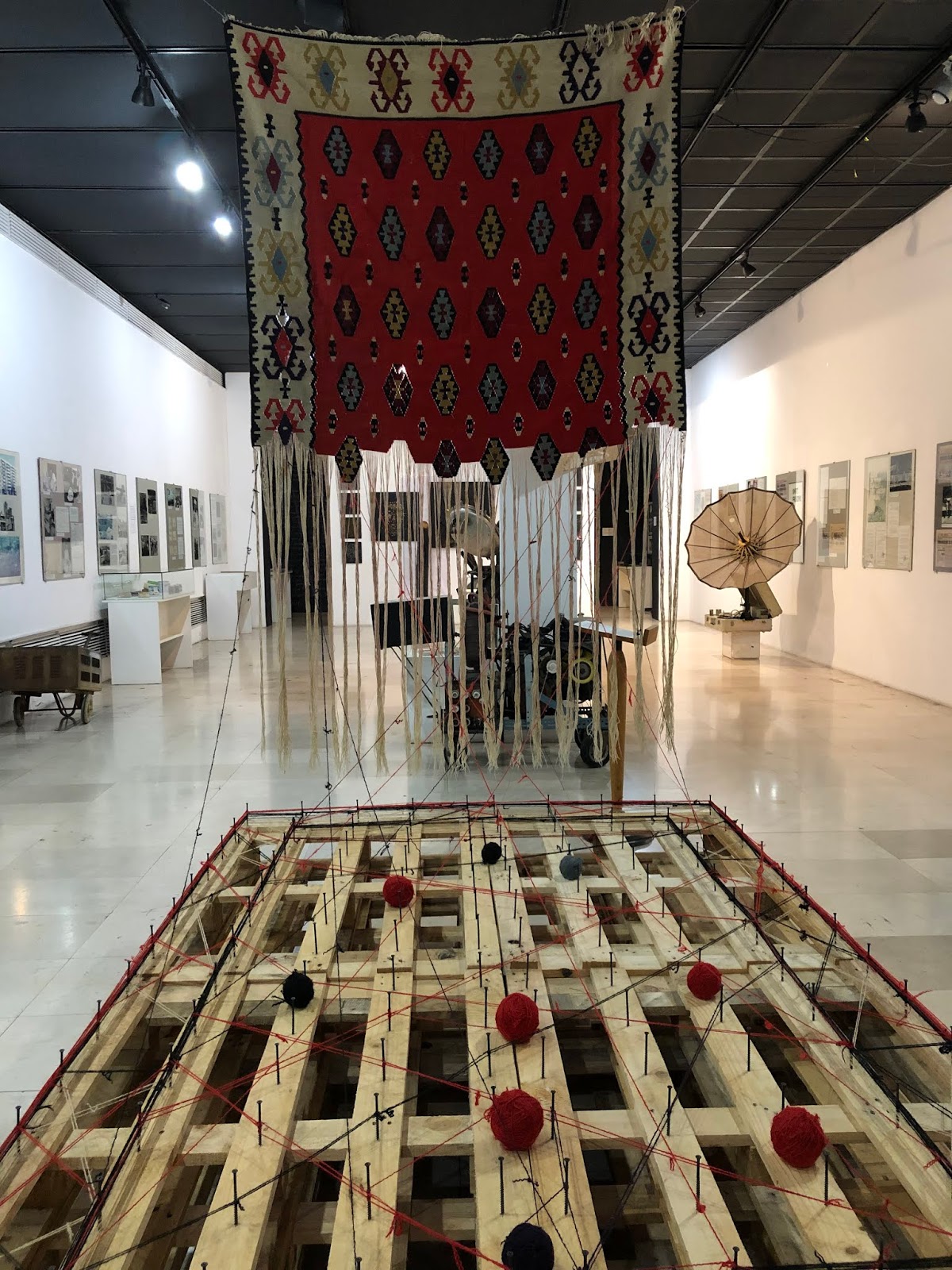
The impetus for our trip to Sarajevo was friend Selma's installation in an exhibit, Reconciliations, which opened on November 26, 2018. A Sarajevo native who went through the Bosnian War, 1992-1995, she suffered the loss of her father, endured sniper fire and shelling, then escaped the city a couple of years into the war. Her teenage journal entries during the siege are gripping, poignant and heartrending.


Bosnia's artistic heritage includes the art of carpet weaving. The unraveling of this carpet demonstrates the lives of war-trapped citizens. All of the tradition and predictability of their lives has come apart. An article in WeTvArabia says:

Reflecting on this unraveling of her pre-war life and the reconstruction of life after the war, the artist has created a powerful installation of a traditional carpet, suspended from the ceiling, unraveling before the audience’s eyes. The unraveled threads are wound around nails on a wood platform, representing interconnections and voices of memory, both literal and phenomenal.

Here is how Selma explained her installation to the interviewer:
“When conflicts escalate into wars, and the wars go on for years and eventually end, the immediate post-war reconstruction takes over. Schools, hospitals and homes are repaired, usually to their original condition, masking any signs or traces of the disastrous events, sadness and human struggle. Is it possible to re-condition something (building, space, soul) to be the same, to feel the same, when it had been wounded, destroyed and deeply scared on the inside? Is there a clear boundary between lives and spaces before the war, under the siege and of the aftermath?” Ćatović Hughes said.

More from WeTv:
The intent of this art installation is to show the intricacy of the impact of the war circumstances not only have on one person, but rather on an assembly of lives that come together as one whole. Celebrating Bosnian cultural heritage of carpet weaving, the threads become the voices of memory. The process of weaving combines numerous pieces carefully constructed into a cohesive and unified composition, the whole. To create a woven piece like a carpet, it takes time, ritualistic order, repetition and predetermined idea of an outcome.

Selma:
“When the unraveling begins, it is undoing everything the long process of weaving had accomplished but at much faster pace. The threads separate, shapes dissolve and become illegible new forms, and colors bleed independently upon the taut white vertical threads as a ghost background,” Ćatović Hughes said.

Read more about this here


It was a privilege to spend several days in Sarajevo, and to see this exhibit, which included other artistic interpretations of the war experience.  One was a series of photographs depicting a small boy whose young life was restricted because of the violence. That boy's life was finally ended by a sniper's bullet.

Another artist set up a room showing how people lived to avoid shelling and sniper fire, and there were relics from the war years that demonstrated the hardships endured by the citizens of Sarajevo, an Olympic city.


Tuesday, December 11, 2018

Vratnik Guest House


 guest-house

  Our Sarajevo lodging was on Hendek street in the Vratnik area, up the hill and east of the Yellow Bastion. Hendek is a typical narrow street that can barely hold one car-width. Many of the dwellings and stairs on the street feel as if they've been there since time began, and maybe they have. Our guest-house is either entirely new or thoroughly remodeled, clean and comfortable. The marble stairs were swept and shiny, and on two levels housed six guest apartments. 

The location of the guest-house was ideal. We walked down steep cobblestone streets to reach the Baščaršija, a centuries-old merchantile area, and from there most every site we wished to see was within walking distance. We walked between 10-12 miles a day around the city.

Vratnik is among the oldest neighborhoods in Sarajevo, at least 500 year old, and would be well worth exploring in more detail on a longer trip. It still has city walls and gates in places. It was walled in the 18th century to make it safe from foreign attacks.


Hendek street


Hendek street


our apartment; we had a bedroom, bathroom, living room and kitchen


kitchen, looking towards living room


living room towards kitchen!


Siege of Sarajevo: 1992-1995

Memorial plaque on the Suada and Olga Bridge. These two women were slain by snipers during a public demonstration about 5 April 1992. They were the first casualties, with thousands to follow.


A Sarajevo Rose. This pattern of a shell explosion is found all over the city, still. Most are not painted red, but they stand out in roads and sidewalks anyway.


Some neighborhoods feature memorials to those from their area who were killed during the war. Each memorial is unique. 


Shell damage remains in parts of the city.


The Olympic City became a besieged city, a war zone, a mere 8 years after the world was in awe at the doorstep.


The 1984 Olympics bobsled run, destroyed and abandoned.


--------The Sarajevo Tunnel-------

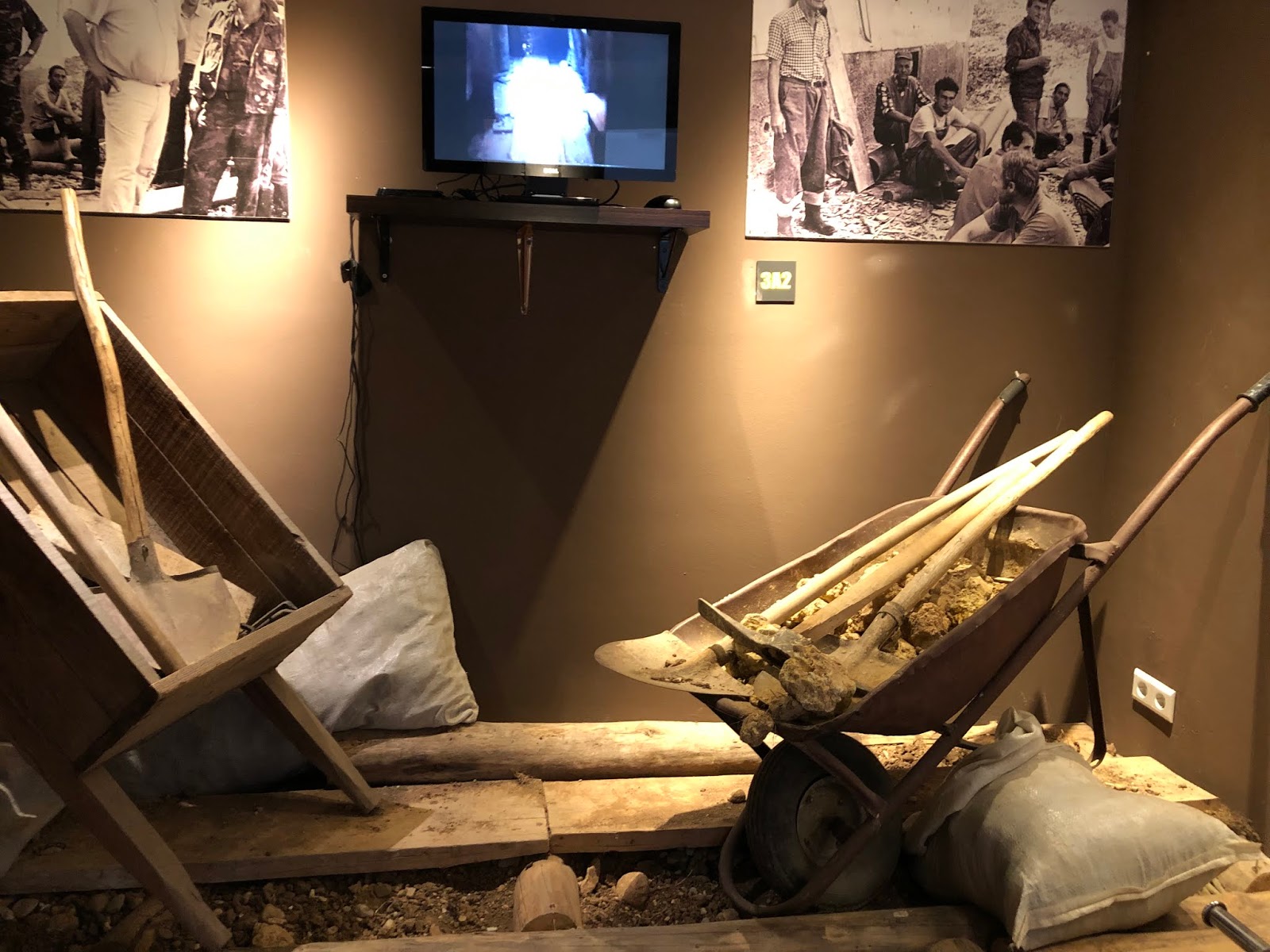
One year into the siege of Sarajevo a tunnel was burrowed under the airport runway to provide access between the besieged city and UN held territory on the other side. Supplies, troop movements, and escapees made use of the passage. A friend, Selma, escaped through this tunnel and eventually made her way to the US. She said Serb snipers were poised for action in the hills above both ends of the tunnel.

Now only a small portion of the tunnel is accessible to visitors. Selma described the cramped-ness of the tunnel. When a stretcher bearing wounded was carried through, anyone else inside had to flatten themselves against a wall.  The tunnel was a conduit for various utility lines for the city of Sarajevo. 


Entrance to tunnel.  A shell landed here killing more than a dozen people waiting to make their escape.


The museum features this model showing the path of the tunnel (white chalk mark). One entered and exited through a house on each end. The airport runway shows in this model.


In the museum are photos and models of the tunnel. 


Digging tools. No backhoes or other mechanized helps were used, in order to keep the digging under wraps.


This museum model shows a wounded soldier being transported through the tunnel

The tunnel and accompanying museum are a must-visit in Sarajevo. One gets a feel for the terrible desperation of people in the besieged city, and the risks taken  by military and civilians to keep the city alive through several years of siege.


Monday, December 10, 2018

Religion in Sarajevo


Sacred Heart Cathedral, Roman Catholic

We made a point of visiting religious buildings in Sarajevo,  Mosques are plentiful in Sarajevo, and I relished hearing the Muslim prayer call once again. Sarajevo features Roman Catholic and Serbian Orthodox churches, and synagogues as well as mosques.


Ashkenazic Synagogue, the only active synagogue left in Sarajevo

This Ashkenazic synagogue, built in 1902, was not open the day we passed by it. I'm still sorry about that. Photos of the interior show it to be a treasure of mosaics and eastern-oriented design. Besides the beauty, I enjoy soaking up the history and devotion in a house of worship. The first Jews in the city were Sephardic who were taken in after their expulsion from Spain in 1492. Ashkenazic Jews arrived about 200 years later. Today Jews in Sarajevo number in the hundreds.


We visited Gazi Husrev-beg mosque. Mosques are treasures of tradition and faith. This one was not open, yet the Imam unlocked it for us to browse as long as we wanted.


A favorite was the Serbian Orthodox Church. The mysticism of an Eastern-Rite church is alluring to me. Even if incense isn't burning during a visit, the walls are permeated with the exotic scent, making you feel as if you've stepped back centuries in time.


 iconostasis painted with icons


 three-barred cross, a symbol of an Eastern-Rite church


Bridget located The Church of Jesus Christ of Latter-day Saints for us. We attended on Sunday, and on walking in met a missionary from my hometown, Beaverton Oregon! I did not know him, but his aunt and uncle lived a few blocks from me for about ten years. He was thrilled to meet someone from home. He did all the translating in the meeting, Bosnian to English and vice versa.


What I loved most about attending church, besides meeting fellow church members in a far-off place, was the  music. The hymns are translated into Bosnian. The language is not unlike my Baba's native tongues--Slovak and Carpatho-Rusyn. I recognized words and was able to pronounce much in each hymn. The familiarity helped me feel at home . . .


Saturday, November 10, 2018

Soviet Tears

hedgehog tank defense just west of Moscow

If you land at Shermetyevo Airport in Moscow, Russia and travel into the city, your route will take in the above monument.

The symbolic crimson-colored defensive barriers, called hedgehogs, mark the spot where the Soviet Red Army stopped Hitler's war-machine at the "gates" of Moscow, in December 1941. Axis forces had bulldozed their way north through the Soviet Union with several million soldiers, a movement known as Operation Barbarossa. Their ultimate goal was to acquire natural and agricultural resources to fuel their army, and to depopulate the western Soviet Union in order to re-people it with Germans.

By the time the Axis came within sight of Moscow in late 1941, winter was setting in. The bitter temperatures and heavy snow grounded the Luftwaffe and drastically curtailed the Axis movements. The Soviet counter-offensive drove them back from Moscow; the Axis never came close to taking the city thereafter.

The hedgehogs are ever a reminder of the firm, heroic stand made by Soviet troops. During five years of war, over 25 million Soviets, military and civilians, lost their lives, about 14 million of them Russians. Thanks to the Soviet people for stopping the German advance, the German bullets, with their own bodies.

In the Museum of the Great Patriotic War in Moscow is a special room that memorializes the dead. This solemn Hall of Remembrance and Sorrow shows a mother with her dead son, encompassed by "tears" falling from above. Perhaps at least one tear falls for each of the many millions whose lives were snuffed out by war. Add to that the tears shed by countless subdued visitors, and you have the most effective war memorial possible. If only tears could end war forever.


Read more about the Great Patriotic War


Thursday, November 2, 2017

August 21, 1968

Dad scooped the Los Angeles Times off our driveway every morning at 5:30. He and Mom usually had it read by the time the rest of us rolled out of bed. This day, August 21, 1968, was different though. We were all up by 5 a.m. preparing to attend cousin Charlie's funeral an hour south in Long Beach, California. Dear Charlie died on the 18th of August after several years of tragic decline due to ALS. He was Mom's first cousin. My angelic father had been the catalyst for getting our family down to visit Charlie almost every Sunday after church, despite the long drive to the nursing home in Long Beach, and later Fullerton, California.

We woke up to the above headline that August Wednesday, the 21st. Our eyes were sleepy, and that front page glared at us from the kitchen table as we ate our rolls and juice, putting a weighty damper on an already melancholy morning. The huge, bold type implies that Times readers should be and would be deeply interested in this invasion and its consequences, and maybe a few were. Our arch-enemy, Russia, had gone rogue again. I suspect that not many folks actually cared about Czechoslovakia, which wasn't exactly on the radar of the average American. Except for us, that is.

Dad's parents had immigrated to the US from the Austro-Hungarian Empire, now the Czechoslovakia of the bold headline, in the early 1900s. Over the decades what with a depression and two world wars, pinching poverty, Grandpa's long hours in the coal mines, the births of eight children, and then Grandpa's crippling mine accident in 1951, they had never entertained the thought of going back to the old country for a visit.

Sometime after Grandpa's death in late 1966, we had word that Baba was considering a visit home. Though her parents and siblings were deceased, she had nieces and nephews who were living, a few of whom corresponded with her. The 'Prague Spring' was warming. Why she did not just pick up and go is unknown. But on August 21, 1968, the opportunity vanished. I wonder now if she would have been trapped behind the Iron Curtain had she been caught in the invasion.

Then followed several decades of silence from her family in Czechoslovakia. I remember the significance of the first letter she received from her cousin Michael Ihnat-Mikula in the mid 1980s. The political climate was relaxing a bit, and he was able to reestablish contact.

After European communism tumbled, Slovakia became independent. In 1997 I traveled to  meet my Slovak family for the first time. A large group of cousins gathered at a home in Humenne to meet me. We discussed their lives and events of the past. The oldest person there was Irina Porochnava Bubnasova. I brought up the Russian invasion of 1968, and wasn't prepared for a wrenching emotional response.

Irina gravely recounted the grief and dread and terror of that August morning. Every woman who had endured World War Two was hysterical. Russian tanks crowned the hills around town with guns pointing towards homes, at these women, at their children. It was the world war all over again.

The vision of Russian soldiers seizing the town, and the women of Humenne reliving erstwhile terrors in their minds, brought forth tears. I couldn't and wouldn't ask Irina about the terrors, but am pretty sure that the same horrors of war going on today in Syria or Iraq are what went on then. My comfortable American self can feel sympathy but can never fully fathom the abominations of war.

Though the 1968 invasion stifled the wave of freedom behind the Iron Curtain, the Russian army didn't occupy long. Life in Humenne and the country returned to normal, albeit a harsher version of it. Less than 25 years later, the Soviet yoke was thrown off, and my family there now lives in light and prosperity and freedom.

City of Humenne
My grandfather was born in a village located on the upper slopes of Vihorlat, the mountain in the background


Humenne's town center

Friday, February 3, 2017

Tragedy in Budapest Hungary, 1945-1946


 A page from Budapest, Hungary death records, 1946; Elizabeth Nobel was shot by a sharpshooter

I index thousands of records a year and most of them are straight forward births, marriages, deaths, obits, muster rolls and so on (if you don't know what Indexing is, click here).  Life's events play out on digititized pages that I download on my home computer.  It's all fascinating to me, to see naming patterns, occupations practiced in various areas, causes of death, and which ethnicities appear where and when.  It's a habit of mine to read between the lines and place the data into historical context.

Recently I was indexing Budapest, Hungary death records for the years 1945 and 1946.   The world war ended and recovery began during those years.  Well, recovery is hardly the right term for the immediate post-war period.  War-devastated European countries had years of turmoil ahead of them as survivors scrambled for food and shelter amidst the rubble of their former homes, searched for missing loved ones, and began the torturous process of punishing traitors and war criminals.

In the Budapest death records are causes of death that are not the usual tuberculosis, pneumonia, cancer, influenza and so on.  Using a weighty Hungarian dictionary given to me by a friend (a Hungarian-speaking former CIA officer) I have roughly translated these causes: shell wound; poisoning; self-sacrifice annihilation by explosion; bomb; explosion and fire; sharpshooter; Buchenwald (and other death camps); shooting by fusillade; aerial attack; explosion causing falling in (presumably the collapse of roof and walls); and execution.  Execution.  Execution.

For seven weeks beginning in late December 1944, the Siege of Budapest strangled the city.  As the one-million-strong Red Army tightened their grip, deaths from shelling and starvation mounted, eventually reaching nearly 40,000 in that short period.   In the area of Budapest where my indexing projects are taken from, the stretch from January 13-19 was particularly calamitous. 

 The arrows indicate the Red Army advance into Budapest in January and February 1945
[from www.flamesofwar.com]

The folks in charge of tracking and registering deaths were likely struggling for survival themselves.  Not until 16 months after the Siege of Budapest are the deaths from that time period entered into the register, interspersed among current deaths occurring in May, June and July 1946.  The war deaths are recorded in detail, even down to the time of day in some cases.  Where this specific information came from, I can't even guess.  And how many deaths were not recorded at all because no one knew what happened to the victims?   In wartime people disappear and bodies can remain unidentified. 

The pages in these registers show the Halasz family who died together when a shell hit their home on January 13, the Nobels, hit by sharpshooters on December 31, and Anna Perlak, who apparently gave up her life to set off an explosion in mid-January, perhaps at an arsenal belonging to the enemy.  The Reicher family home exploded on January 13, killing three inside.  A curious death is that of Alice Frances Meadows, age 64.  It doesn't give her nationality but she was in English teacher in Budapest.  She was shot down by a fusillade of bullets on January 5.  One wonders why she didn't get out of the war zone when it was still possible.  Surely her Allied connections would have been a ticket out of Dodge if she tried to leave early in the war.

The executions.  Almost all of these were Hungarian men between the age of 21 and 50.  The method or reason is not listed, but the time of death is.  It appeared that about every 15 minutes on some days in June and July 1946, executions were carried out.  Some of the men were married and / or had parents still living.  Did they collaborate with the enemy?   Steal food from their own troops to feed their families?  Perhaps they deserted the Axis lost cause and were apprehended after the war.

Budapest when the siege was over

Steeping myself in these pages brought home the tragedy of war.  Real individuals suffered tangible tragedy in one of the world's great cities.  Death did not discriminate.  Why this has to repeatedly happen to certain populations (or to anyone) is a question with no answer.