Showing posts with label Southern California. Show all posts

Saturday, January 25, 2025

FIRE in California

My sister AK has lived in Malibu California for about 25 years now, in an area called LaCosta. Their house sits about halfway up the mountain and has a grand view of the Pacific Ocean, Santa Catalina on a clear day, Malibu Pier, and daily sunsets. Great view, but I would not say this is an easy place to live. It's extremely hilly and designed without consideration for pedestrians, so just going for a walk is not a casual decision. Forget about riding a bike here, unless you're at the level of Lance Armstrong. The infrastructure isn't great. Houses are on septic, and the electricity periodically goes out. The city is sliced by a major high-speed state highway, locally known as PCH. If you want to get to the beach, it must be crossed, just like Caesar crossed the Rubicon. And it would help to have the Roman Army to escort you safely across, because you have about a 50-50 chance of coming out alive.

Periodic brush fires damage or destroy parts of the city, the boundaries of which stretch about 28 miles east-west. Fire in one end of the city might not be much noticed by those in another area. Floods generated by heavy rains cause trouble, especially after a bad fire season has burned off the root system that holds soil in place.

On January 7th 2025 the worst happened. About 10:30 a.m. a fire erupted in Pacific Palisades, east of Malibu, on a day when the devil winds--the Santa Anas--were screaming off the desert (and they really do scream). By 2:30 p.m. AK's family saw the writing on the wall and left for safety. For several days they knew nothing of their house or neighborhood until a helicopter's video showed up on the news. From a distant camera shot they could see their house still stood.

A "happy" ending for them was not shared by thousands of other homeowners. On January 23 AK's family was allowed back in to the neighborhood check on their house. Miraculously there was no damage to the structure. The fire burned around all four sides of the house. The house close to them next door burned to the ground. All of the patio furniture on their back porch was incinerated. Yet there is little ash or soot inside. Utilities are fried so they won't move back in until the infrastructure is repaired, or rebuilt. Six of the 10 houses on their street are gone, as are most on adjacent streets.

I stole the following map from the website www.ktla.com, which is a long-time Los Angeles area news station. The map was created and distributed by the LA County Fire Department. It covers the entire area of the Palisades and Altadena fires, and the portion below is centered just on my sister's area of LaCosta in Malibu. Each of the marks represent a structure, and if you were looking at this online, you could click on each and a pop-up window will give you a few details plus some photographs of what each structure looks like since the fire. Fire investigators have done a fascinating on-the-ground investigation.

Damaged or Destroyed Structures
Destroyed (>50%)
Major (26-50%)
Minor (10-25%)
Affected (1-9%)
Inaccessible
No Damage


This screenshot shows AK's neighborhood area in Malibu. The houses right along the beach in the lower part of the pic [the red row] were almost entirely obliterated. In the center of the row is a black square representing their beach club, which survived. 

The beach club exterior is stucco (a concrete coating) and the roof is tile; AK's house is also built of those materials. Those 2 elements may be a common denominator in structures that survived. Someone will surely do a scientific study of exactly what saved one structure and not another. Then surely, Malibu will adjust its building codes accordingly. Surely. Sure they will. Sorry, in my observation Malibu is not proactive in enhancing or protecting the lives of its citizens whether it be pedestrians attempting to cross the 4-lane-death-trap PCH, or in providing reliable utilities, etc.
 

The above map zeros in on AK's immediate area. The devastation is profound; most of her neighbor's houses are gone. Will the area ever return to its pre-fire self? Will people rebuild or sell out and leave? 25 years ago AK said, "I know my house will burn someday," because that is a fact of life in Malibu. Well, her house survived the 93 fire and now the Palisades Fire.


One more map, this one showing the devastation further east in Pacific Palisades. Neighborhoods are denser here so the results of the fire are horrendous. Not only are entire streets wiped out, but entire sections of neighborhood. So many questions. What to do? Where to start? How to repair? Who will pay? How long will it take? All of those questions will have answers, eventually. But the biggest question cannot be answered: When will the next conflagration hit?


Monday, November 27, 2017

Adohr Milk Delivery

A favorite quaint memory of mine is that of the Adohr Man. In the 50s and 60s homes in our San Fernando Valley neighborhood had dairy products delivered to our front porch by Adohr dairy. Adohr Farms was at 18000 Ventura Blvd. in Tarzana, California (founded 1916!). Adohr had the largest Guernsey herd in the world, but we didn't know or care about that as kids. I just now read it on the internet.

Here's how home delivery worked: The night before our regular delivery day Mom put last week's empty milk bottles into the wire crate (see photo below) Adohr provided, and set it out on our front porch. A rolled up note was stuck into the neck of a bottle with our order for that day, as to how many bottles of milk we needed. And that was that. The next morning ice cold bottles of fresh milk magically appeared on our porch.

I remember that later you could get eggs, butter, cheese, and other dairy-related items delivered also. Am not sure if Adohr did that, or if another service delivered those items. Adohr milk was deliciously thick and creamy. Once in a while a bottle got knocked over and shattered all over the floor; that was tragic. Milk was more glamorous when it came in bottles.

Home delivery was a boon to families like ours who owned only one car--that was the norm then. In suburbia there was no nearby walk-to corner store selling the daily essentials. Once Dad drove off to work, Mom was stranded at home. Not only could Mom not run to the store any ol' time, but in fact, Mom didn't even drive until I was 5 or 6 years old.  The Adohr Man kept our young, growing family in milk.


Adohr Farms
Adohr milk bottle

Adohr crate
Adohr in the early days


Tuesday, November 22, 2016

POO-PITCH, POOP-ITCH, POOOOOP-ICH: My Mom's Brilliant Scheme

 
 Mom--Dad--my sister Nancy in our backyard about 1963

Mom was the architect of small but important ideas that enriched the lives of her children. She taught us how to braid by hanging up a piece of cardboard with three hanks of yarn attached, for us to manipulate. She taught me how to ride the city bus so I could go to my grandparents' house for the weekend--at about age eight. She ran us kids through 'decorum drills' so that we were able to be smooth in the presence of company. And her prescience now and then headed-off potentially harsh or embarrassing moments in our lives.

Dad worked in the field of forms design and management for Lockheed Aircraft Co., located at what is now Hollywood-Burbank Airport. His office, in Building #9, was right next to the air terminal. Offices were formal then. Men wore white shirts, dark suits and conservative ties every day. Women wore suits or dresses, heels and jewelry, and got their hair done every week. Work hours were 8 to 5, and they meant it. Most families had one car as did we, so Dad carpooled to work with other men in dark suits. To sum it up, white collar work was a stiff, regulated, button-up environment.

One fine day when I was about nine, Mom announced that we four children were going to visit Dad's work on our way to an event. What a rare treat! We would wear our Sunday best, and for weeks we brushed up on our manners. We practiced hand-shaking, curtsies (bows for my brother), our "how-do-you-dos" and "pleased to meet yous." We would be meeting Dad's co-workers: Mr. Benedon, Mrs. Knaack, and a staffer named Pauline Pupich.Yeah, that last one was problematic. Mom knew just how we would react to meeting Miss Poop (ich). It wouldn't be pretty. In fact, it would look about like this.

Mom approached the problem this way. If she said the name Pupich hundreds of times before we actually met Miss Pupich, we would get our laughs out of us, and be straight-faced at the critical moment. So for weeks at very unexpected times, Mom uttered the word, Poop-ich, with an emphasis on the 'POOP,' in our presence. She could be in mid-sentence, say the 'magic' word, then continue on with her thought. She delivered it while tucking us in at night, while serving up dinner, and when she breezed through the room while we did our homework.

Presto! It worked. We silly kids were so tired of hearing it, that when we met beautiful blond Pauline Pupich, not a laugh crossed our lips. Mom was so proud of us; I think we got some kind of reward. Really, Mom deserved a reward for her brilliant strategy. We kept our dignity and so did Pauline.


NOTE: After writing this I wondered about Pauline. She was probably in her late 20s at the time of our only meeting. A Google search showed she was born in CA in 1934, in 1955 was a student at Valley College, and was active in student affairs. She married John Richmond  in 1968. I found a 2012 obituary of her brother Milan that said Pauline pre-deceased him. Further search shows she passed away in 2007. And she is buried in the same cemetery as my Mom. Mmmm.  Life can be so strange.

Saturday, November 12, 2016

Geologic Fraternal Twins

The red line shows the course of the San Andreas fault.  Tejon Pass and the Grapevine are at the letters TP near the map's lower center.  Cajon Pass  is on the lower right denoted by CP.

Parents of twins are known for naming their children similar names:  Zella and Zelda, Dan and Don, Lacey and Lucy. Southern California has twin mountain passes--Cajon and Tejon--that guide a south-bound traveler into heavily populated basins circled by dramatic rugged mountain ranges. It's only a coincidence that the pass names are twinny.

On the drive south on Interstate 5, traffic climbs out of Central Valley up the steep winding 'Grapevine' through Tejon Pass in the formidable Tehachapi Mountains. Contrary to popular belief, The Grapevine is not named for its knarly twists and turns that resemble a fruiting vine braiding it's way up an arbor. The wild grapes that grew along the original narrow road lent their name to the area. The famous Butterfield Stage line between Los Angeles and San Francisco traveled through Tejon Pass.

85 miles east of Tejon, Cajon Pass leads traffic from the high Mojave Desert down into the Inland Empire communities of San Bernardino and Riverside. A funky formation called Mormon Rocks lies west of the pass, so named for the Mormon wagon train that passed by in 1851.

Four score miles apart as the crow flies, these "twin" passes have a commonality created by the San Andreas fault which has spawned them both. Their imposing, dramatic scenery distracts drivers all the time. If you know when and where to look as you navigate through the two passes, you can detect where that major earthquake fault slices through the mountains to the left and right of the freeway. 

 Nasty brush fires periodically sweep over the passes in the heat of summer.  Both have horrid winter weather that results in regular road closures (during college Craig took a bus home from Utah without hitting snow until 35 miles from home at Cajon Pass).  Most interestingly, the elevation of the two passes is nearly identical: 4160 feet for Tejon Pass and 4190 for Cajon Pass, an insignificant difference in geologic terms, yet it's kind of eerie for Southern California's two main points of entry to be that similar in elevation.

It has always intrigued me that these two important points have similar names, elevations, and features, and even parallels in their history. Earthquake activity from the San Andreas Fault is the chief factor that created the massively steep and spiny mountain ranges, and future fault movement will continue to bend and squeeze and thrust up these ranges.

Monday, November 24, 2014

"There it is. Take it."

 William Mulholland, 1924

William Mulholland is memorialized in the name of the swanky, serpentine mountain road called Mulholland Drive that skirts the mountains north of downtown Los Angeles.  An Irishman, seaman, zanjero (ditch keeper), and brilliant self-taught engineer, he eventually rose to the position of superintendent of the Los Angeles Water Department.   When you know how important the management of water was in arid dusty burgeoning Los Angeles, you know that Mulholland rose to that post because he knew what he was doing.

Except when he didn't.  I'll get to that in tomorrow's post.

From the 1880s on, Los Angeles and the rest of Southern California was promoted to Easterners as a healthful agreeable place to settle, and the people came in droves.  They raised stock, cultivated farms, and before long the sweet aroma of tens of millions of lemon and orange blossoms wafted across the land.  The Mexican system of irrigation--ditches diverting the meager Los Angeles River--shortly became inadequate.

a Los Angeles-area scene, early 1900s; wouldn't you want to live here too?


Enter William Mulholland.  By 1887 he was in charge of water in Los Angeles.  Population boomed, growing from 50,000 in 1890 to 320,000 in 1910.  Los Angeles was and is a desert.  The Los Angeles River swelled only when rain or snow fell in the mountains.  Water would have to be brought in from somewhere else.  Somewhere else was the key to LA growth.  Somewhere else turned out to be the verdant, cultivated Owens Valley, 230 miles to the north.  Through a series of shady deceitful dealings by multiple people (including Mulholland), Owens Valley was drained of it's lake and river.  The water was channeled through a brand new massive aqueduct system to supply Los Angeles with liquid gold.  100 years later, that aqueduct is still imperative to the survival of that city.  A second system was added in 1970.

The terminus of the aqueduct was called the Cascades.  The pipe came from the north through a mountain at the northern most point of Los Angeles, and spilled through flood gates to the south.  Water, this expensive purloined water, tumbled down a channel into San Fernando Reservoir, a series of lakes that cradled the liquid gold Los Angeles craved.

a portion of the Los Angeles Aqueduct under construction, 1913

I grew up in the shadow of the aqueduct.  I have passed the Cascades thousands of times.  I have seen the barren Owens Valley.  I have tried to visualize it as it once was: a place of verdant growth and abundant agriculture before Los Angeles got hold of it.  Hardly a year in the last hundred has passed without some aspect of Los Angeles's water-related transgressions tied up in the courts.

On November 5, 1913, a triumphant Mulholland stood at the steel wheel that would release the water taken from the few, for the benefit of many.  As he turned the wheel, Mulholland said, "There it is.  Take it."   And it was done.  Los Angeles got what it wanted, thanks to William Mulholland.

the first drops of Owens Valley water arrive at the Cascades to slake thirst in Los Angeles, November 5, 1913


November 5, 1913: opening day at the Cascades, the southern terminus of the Los Angeles Aqueduct; Owens Valley water filled San Fernando Reservoir (not shown in photo), supplying LA with the water that further fueled its growth
(an interesting side note: Interstate 5 now runs horizontally where the long crowd of people is standing)


TOMORROW: "I Envy the Dead"

Sunday, November 16, 2014

My Trump Card

Joshua Trees are thick in the Mojave

In the mid-1970s our family lived in the Mojave Desert while Craig worked as an engineer on top-secret military projects at Naval Weapons Center. I did a lot of reading during those years about that lonely, wild, and breathtakingly beautiful part of California.

Besides being the historic home of tribes of Mojave Indians who had all but disappeared, early explorers had passed through the desert and nearby Sierra Nevada Mountains. Rich veins of ore were discovered, giving the rugged area a legendary mining heritage--gold, silver, lead, zinc, borax, and other valuable deposits came out of the Mojave and surrounding mountains. In my extensive reading I became familiar with mine locations and major players in the industry in the 19th century. Cerro Gordo was the big daddy of mining operations in the Sierra Nevada.

Fast forward 25 years to the 1990s. My sister Alice and I spent a few spring vacations camping in the wilderness of Death Valley. We drove for miles off-road, set up camp, cooked over our fire, endured violent "banshee" windstorms, hiked, and enjoyed the dramatic scenery. Those trip are among my favorite memories ever.

our Echo Canyon campsite in Death Valley

This one spring we stayed a night in Lone Pine, a town near Death Valley, the first night of our camping trip. I don't remember why we didn't camp out, but we might have gotten up near Death Valley too late in the day to find a place to set up for the night. Anyway, we grabbed some dinner at a small diner, and got to talking to the folks at the next table. We mentioned to one fellow that we were interested in seeing the old mining town of Cerro Gordo. He said the settlement was now privately owned, but that he --Tom--  was close friends with the owner --Dee-- and that it was ok if we drove around the road barrier she had set up to keep looky-loos out. When we got up there we should tell her that Tom gave us permission.

The next day we did it. Drove out to the foothills, drove around the road barrier, and the SUV crawled up the steep, windy dirt road to the old mining camp high in the mountains. As we pulled into Cerro Gordo a woman, who turned out to be Dee, flew out of one of the old houses demanding to know what we were doing there--didn't we see the barrier down below? We blamed our presence on Tom. Dee exclaimed she was preparing for weekend guests and didn't have time to have tourists around. She saw a couple of our children in the car and decided she had a moment to give us a quick look at one of the old houses and off we went.

the mining boss's house

In the front room of the house Dee related a nutshell history of the Cerro Gordo Mines. I glanced around and saw a man's photo hanging on the wall. When she paused I blurted out, "Hey, that's Mortimer Belshaw!" She was struck dumb for a few moments. Mortimer Belshaw was the man who made Cerro Gordo profitable (and himself wealthy) by figuring out a way to get Cerro Gordo silver hundreds of miles south to Los Angeles. Well, remember the extensive reading I referred to above? Belshaw was a star player in Mojave-area history, and I had not forgotten him. I had played my trump card, I had passed GO and collected my $200. And I'm really glad he had an outstanding name that was easy to recall.


Mortimer Belshaw

Well, a startled and amazed Dee thawed out right there in front of Belshaw's photo; I had apparently been the first person ever to recognize the man. She gave us a tour of the rest of the house, and then declared we could take our time looking around the town as long as we stayed away from the mine shafts. We lingered, explored, and even bought a couple of local history paperbacks in the dusty cluttered museum. On the way down the mountain the SUV had trouble; even in low gear and with Alice's foot firmly on the brake, it was hard to control speed--the road was that steep. Poor Alice had to buy a new transmission after that trip, but it was worth it to have a once-in-a-lifetime trip to remote, secluded Cerro Gordo.


Saturday, November 15, 2014

William S. Hart's Horseshoe Ranch


William S. Hart

In 1946 a well-known silent film star, veteran of scores of Western movies, passed away on his ranch in Newhall, California.  HIs name was William S. Hart, star of early pictures such as Ben-Hur (1907), The Gunfighter (1917), and Tumbleweeds (1925).   He counted among his friends Tom Mix, Maurice Chevalier, Charles M. Russell, Frederick Remington, and other celebrities.  He knew Bat Masterson, Wyatt Earp and Will Rogers.  From Newburgh, NY, he had begun his acting career on the stage in New York City in 1888.  About 1913 he headed west to act in Westerns, met a pinto named Fritz on a set, and became known for films that portrayed the West as it was: rustic and rugged, harsh, dusty, full of really really bad folks, some good folks too, and a place of boundless sweeping vistas.

Hart on his beloved horse, Fritz

About 1921 Hart bought land in the foothills of the Santa Susanna range on the south end of Newhall, and named it Horseshoe Ranch.  He built a Spanish-style hacienda he christened La Loma de Los Vientos, a bunkhouse, stables, and other outbuildings, and put in a swimming pool surrounded by a sunny plaza.  Hart collected guns, including several that had belonged to Billy the Kid.  He loved Western art and acquired some Remington and Russell originals, and Navaho rugs and artifacts.

La Loma de Los Vientos

Before his death Hart did something so magnanimous, so brilliant and far-sighted.  In his will he left Horseshoe Ranch to the people of Los Angeles County with the stipulation that it be open to the public for free.  Yeah.  And his slice of heaven on earth became my family's slice of heaven on earth, a favorite destination from about 1959 on.  We picnicked here, we hiked the acres of oak-dotted hills, tarried at the corrals, collected peacock feathers, looked for the hoot owl that lived in the shack.  We relished the Charley Russell art, the Remington sculptures, the antique guns and thrilled at the grizzly bear rug in the upstairs living-room.  From the pleasant terrace we gawked at craggy chaparral-covered ridges, the buffalo herd down the ridge, and the panorama of the Tehachapi Mountain Range miles to the north.  I have spent a heap of happy hours at Hart's ranch.

entrance to the ranch

foyer and staircase

Hart's living room

Hart's gift gratified the local community.  The first high school in the Santa Clarita Valley was close to opening at the time of his death, and it was decided to name it William S. Hart Union High School.  And that's my alma mater, class of 1972.  I don't know if there are other schools named after movie actors--that can be a roiling pit of quicksand, given reputations common in that occupation.  Not that Hart was perfect, but he had been a good neighbor and community contributor for decades before his death.  [NOTE: read here for another kind action by Hart]

Hart must be smiling down from above at the joy four generations have experienced at his ranch.  His reason for giving his estate to the public, was simply this:


"When I was making pictures, the people gave me their nickels, dimes, and quarters. When I am gone, I want them to have my home." -- William S. Hart

Monday, March 15, 2010

Childhood Automobiles

Personally I don't care a lot about the car I drive, only that it isn't butt-ugly [think Citron or Studebaker] and doesn't break down on me. And I've been pretty lucky on both those points with a couple of exceptions. Here's the cars that were part of my life before I got married. Will cover the others later.

Chrysler? green. This car [see below] is one of my vague early memories. Perhaps this is the same car Dad called a Plymouth Deluxe which he bought new for $1800 in 1950. Am not sure except that car was green. Looking at this Plymouth Deluxe I saw on the internet, I would say yes, that's the car.  Only not purple and am pretty sure it did not have whitewall tires.


1956 Buick Super, gray, with those holes in the front side panels. Holes in the front side panels seems like a strange choice of decor. Dad said driving this was like driving a truck. This car could drive off a cliff and land unscathed, it was that massive. Here it is in all its bigness:


1957 Cadillac, blue. Dad bought it used for $800. It was similar to the above photo but the blue was lighter.


1961 Buick Special station wagon we bought brand new for $2500. It was white with red interior. Dad drove us from California to New York and back again in this car in 1962. No seat-belts!  The kids horsed around in the 'way back' which was cold red metal. I learned to drive in this car in 1970 and later ruined the transmission by putting it in park before it was completely stopped. Picture this in white with all 6 of us squished in it:


1962 Pontiac Tempest, creamy yellowish; bought from a VP at Lockheed where Dad worked. It was so sluggish which was annoying and possibly unsafe. Dave used to yell to Mom while she was driving, "look out, you're gonna hit that car/ person/ fire hydrant/ curb/ etc.!" [couldn't find good photo]


1964 Chevy Impala, originally gray until we painted it a sicky blue; a sea-worthy land yacht. I got hit in this car about 1971 and it hardly made a dent. To be fair I have to confess that the car was at a standstill at that moment, but was hit by someone going about 40 mph. We bought it from our friend Bob Price.


1964 Oldsmobile Ninety-Eight, light blue, bought from our friends the McCollums (Neil and Pat) who always had way nicer cars than we did. The photo below is that car parked at Mt. Pinos with me at the wheel, but don't worry I wasn't driving at age 14. I was recuperating from a nasty toboggan accident that occurred an hour before.


1967 Dodge Dart sedan, dark green. My favorite car because it was the closest to "cool" that we ever owned. It drove well and was responsive. It had a bad habit of getting a stuck choke so I figured out how to remove the lid to the carburetor, stick a pencil in the choke, start the engine, remove pencil, replace lid, close hood, drive away.  It helped to not be in a hurry to go anywhere. Picture this car a deep forest green:


1972 Buick Skylark light creamy tan-yellow. Bought brand new in the San Fernando Valley (from Walter Ruff dealership?) for $3900. Driving home from the dealer it balked going over Newhall Pass and we found it had a crimp in the gas line. We had a devil of a time the next day getting it back up over Newhall Pass so the dealer could repair it. This car was the most "luxurious" we ever owned.

Sunday, January 31, 2010

An Early Sign of My Future Senility

From 1977-1978 our family lived on the military base in China Lake, California, where Craig worked at the Naval Weapons Center. He helped design Sidewinder Missile (I guess it can be mentioned now, even though it was top secret then).

Every week I made a trip to the public library to check out fat novels and return the stack from the previous week. I had this habit of setting the books on top of the car while buckling my baby into his car seat. Then I would grab the books and set them on the front seat. Except for this one time, when I forgot they were up there.

I happily cruised away from the library down Ridgecrest Blvd., the town’s main street, at the 25 mph speed limit. What a grand sight I must have been that sunny day, with the breeze ruffling my hair, and my elbow resting on the fully-open driver's window, looking like I had the world by the tail. Except there was a stack of library books on top of my car.

I turned left into the base and stopped at the guard shack where a handsome young uniform checked my ID. He stared at me intently (was I not the foxiest chick he’d seen all day?) but he never said a word, then waved me into the base. At home in the driveway I got out to unbuckle the baby and my eye caught something on top of the car. For cryin' out loud! I had left the books on top of the car and every one of them was still there just like I had left them! And that guard had said nothing! He hadn't thought I was foxy, just a major idiot. He must have had a jovial time over a beer at the mess hall that night, telling the story of that wacky mom who cruised Ridgecrest with a stack of books on top of her car.

Wednesday, November 11, 2009

A Rude Awakening (Part 2)

 another freeway damage photo

[continued from yesterday]

Sometime during the day of the quake, our electricity came on. That night all six of us slept together in our parents’ king-size bed, although the word “slept” doesn't really describe the situation. We dozed on and off but the near-constant shaking made true sleep impossible. Dad kept his favorite talk-radio station on all night, perhaps so that we would feel buttressed by the calming company. Our new neighbors across the street weathered the aftershocks in their car for the next few days, refusing to go back into their house. A few weeks later they moved back to Michigan.

The following Monday we went back to school, and everyone had earthquake stories to tell. Our PE teacher Mrs. Cheek had a good one. She described how the quake hit as she was talking to her mother on the phone, and she actually saw a series of waves going through her floor. Mr. Dickinson was an aged Humanities teacher at school. On February 8th he had given his annual lecture on earthquakes, describing what the ancients in various cultures believed about quakes. He alleged that he had jinxed us into experiencing a quake sixteen hours later. The following year he was my teacher, and when he gave the earthquake lecture he warned us to be prepared, because, “you know what happened last year after I taught this lesson.”

Gradually the damaged structures were torn down, the freeways were rebuilt, and repairs made around our homes. Dad rebuilt our stone fence [picture below]. I haven’t driven under a freeway or across an overpasses comfortably since earthquake day.


Major earthquakes are more than an initial terrifying shock. They are followed by countless aftershocks, over and over and over, around the clock, for days and weeks. Then they begin to diminish in size and taper off in numbers, and you find yourself finally calming down and able to relax once again. Then out of the blue, just to make sure you’re still paying attention, a five-pointer comes along and a new period of nervousness begins again.

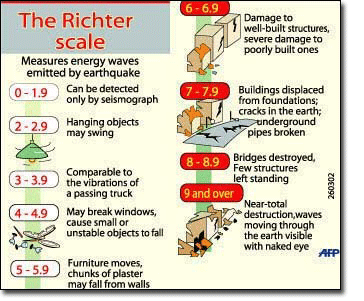
The frightening thing about earth movement is that you don’t know how intense it is going to become. When a quake begins you snap into high alert, and then you have maybe a second to decide which way it’s going to go and act appropriately—will it increase in intensity or fade away? One night weeks after the '71 quake some friends from Agoura were visiting. An aftershock hit and quickly intensified. Our family darted to the doorway for safety. Our friends sat immobile, and asked what was the big deal. It was impossible to explain to them the terror we had been through. I have been in sizable quakes since 1971, but never one so frightening as the early-morning Sylmar quake.  Scientists in my area of NW Oregon tell us that we're ripe for an 8 or 9 intensity earthquake. That's an event I hope to miss out on.

Tuesday, November 10, 2009

A Rude Awakening (Part 1)


On the evening of February 8, 1971, our family engaged in our usual weeknight activities. Some of us had homework; I studied for a dreaded chemistry test. Dad watched something on television and Mom read a book in her favorite spot on the couch. Just before heading for bed, Dad removed the empty Sparklett’s five-gallon glass water bottle off the water cooler, then loaded on a new bottle. We all hit the hay, but little did we know that our lives were about to be disrupted in a way we couldn't have expected.

5:59 a.m. Tuesday morning. Talk about a rude awakening! The monstrous roar of the ripping earth startled me awake just as the shaking began. The noise was akin to jet planes accelerating in our front yard and I was momentarily petrified. The fleeting thought crossed my mind that yes indeed, California is sinking into the ocean. My room reeled and rolled like a rodeo bronc. I wanted to bolt for safety--my room was on the first floor and I didn't want to be squashed by a falling ceiling--but the best I could do was slide out of my bed onto all fours and claw my way over the other twin bed towards the door. On my way over, the hutch flew off the dresser onto the bed, cutting my leg. The shrieking of other family members compounded my terror. The sound of smashing glass gave the impression the whole house was about to come down. When I made it to my door, in the dark I could see the rest of the family hanging onto each other and gripping the stair railing as they frantically half-slid down to the first floor. Mom was alarmed for in the dimness she saw a motionless figure prone on the front hall tile, which turned out to be, not an injured child, but the artificial tree that was ordinarily in standing position near the staircase. As the shaking subsided we all hugged at the bottom of the stairs.

We collected ourselves then toured the damage. The kitchen was in chaos. All of the cabinets and the refrigerator had opened up, spilling and mixing food with broken dishes and glass on the floor. Added to that was the five gallons of Sparklett’s water, creating an unappetizing soupy stew to clean up. Gradually neighbors began to come out to compare damage. In our immediate area the most common problem was cracks in the walls and in the brick chimneys, and fallen or leaning exterior stone fences, all of which our house had. This quake, called the Sylmar quake, was a 6.6, not a world class shake at all.  But it lasted a lengthy 59 seconds. There were about seventy deaths, most due to the collapse of freeway bridges and a couple of hospitals. We were without power and phone but we still had our well water.

It took the better part of the day to clean up the mess. There was a moment of comic relief when our dog helped herself to leftovers that had been ejected from the fridge. School was canceled for the rest of the week. I heard the chemistry lab suffered serious damage, and on the bright side of the earthquake, my chem test was postponed, which gave me more time to get a grip on the material (not that it helped). The grocery stores had a major job cleaning up their broken glass and damaged products. Some houses in Newhall were knocked off their foundations or partly destroyed. Dramatic destruction occurred at the freeway interchange in Newhall Pass. The sweeping concrete curves sailing above I-5 were sliced in half, the fallen portion smashing onto the freeway underneath. Mangled rusty tentacles of re-bar poked out from the debris like ghastly fingers grasping for help. (Almost identical damage occurred here in the 1994 quake). Further down near San Fernando two commuters died when an overpass fell on their pickup, leaving it a flattened 18 inches high.

Newhall Pass after the quake


Tomorrow: Recovery