Saturday, November 14, 2015

An Answer to Prayer

 Dad and my step-mom, Hazel

Our son Blair married Emily in the Portland Temple of The Church of Jesus Christ of Latter-day Saints, in April of 2000.  We so looked forward to the day, yet there was a little nervousness on my part because my dad and step-mom were coming for the festivities, and they are not members of our church.  That didn't matter to anyone.  The awkward thing was that they would not be able to attend the actual ceremony, because only church members are permitted in the temple, and even church members must qualify for a 'temple recommend' that attests to them living the standards of the church.  I explained this to Dad way ahead of time, but still.

When I had married in 1974 this was an issue with my folks.  I was the first of their children to marry, and the oldest daughter to boot, and naturally Dad looked forward to walking me down the aisle.  Twas not to be, as I had joined the LDS Church several years before and would be married in the temple.  My folks were unhappy about sitting in the foyer of the temple while the ceremony was performed upstairs in the Provo Temple.  The situation was repeating itself with Blair's marriage and it dredged up old feelings for my Dad (Mom had passed away in 1994).

I was at the Portland Temple one winter day in February of 2000, 2 months before the upcoming wedding.  I pondered the situation with my folks and sincerely hoped for a good experience for them.  They would be coming all the way from the East Coast to attend.  Inspiration came to me to talk to the gardeners on the temple grounds.  Perhaps the beauty of the grounds on the wedding day would be a sweet consolation.

I spotted one of the gardeners at the downhill side of the temple, and asked him what to expect on that day 10 weeks ahead.  He startled me by whipping out a small notebook from his shirt pocket and flipping the pages to April 28.  He began to read the list of plants, trees and flowers that would be putting on a show that day.  I hardly remember the specifics now, but he worked down the list and it was long.  It stunned me to think he could predict the future with that much certainty.

On April 28 we assembled at the temple, and even though I have seen scores of lovely days at the temple since, I would say that day was the most beautiful ever, given all that was bursting in bloom--the tulips, the flowering cherries, the azaleas, and the rhodies beginning to show color.   The most wonderful thing, an answer to prayer, was that for years after, Dad commented on the perfect loveliness of that day at the temple.  That was the memory that stayed with him above all others.


Friday, November 13, 2015

Rails to Trails

 the Banks-Vernonia Railroad

As railroad lines fall into disuse (and as sad as that is) a wonderful movement has been sweeping the country the past 20 years.  Old rail lines have been converted to hiking and cycling trails.  The rails are pulled up, the roadbed smoothed out, and voila!   Well, it isn't quite that easy, what with the dangerous high trestles (seen above) and the trees and brush that have to be cleared.

The Banks-Vernonia Trail is not far from my house and I have hiked on it many times.  At first only a short portion was available for use, but now you can truly hike from the small town of Banks all the way to the smaller town of Vernonia.  It's probably about 20 miles from end to end.

It used to be that when the trail came to one of the high trestles that you had to scramble down to walk below the trestle.  It's too scary to walk across, and hikers weren't supposed to do that anyhow, for safety reasons.  Now the trestles have had a floor and sides added to them so they are perfectly safe.

Casual cyclists love these trails because their grade is so gradual, which is what a railroad grade is.   It's a major plus to be able to hike away from roads and to have views you don't get from the road.  Outdoorsy people have flocked to the B-V Trail.   Rails to trails is a fabulous idea.  I hope to see more of our area's little used tracks converted over for hiking and cycling, including the Burlington line with its mile-long railroad tunnel.

Thursday, November 12, 2015

I Am a Proud and Grateful Recipient


Last week I became the proud bearer of a New York Public Library Card!!   I haven't lived in New York since 1955, so how did this happen?

 The New York Public Library is seeking applications for Short Term ...

The main library on 5th Avenue in New York City is a marvelous place.  The building is a Beaux Arts style Vermont-marble temple of learning and education, a thing of tremendous mass and beauty.  Dedicated in 1911 by a sitting US President, William Howard Taft, the library is a National Registered Historical Landmark.  88 miles of shelf space are contained here.  Two lions guard the entrance, Patience and Fortitude.  Collections have their own private rooms as do  pursuits such as history and maps.  I walked forever up and down the halls before I ever saw stacks of books such as dominate every other library.  They are kept in the Reading Room.  At my local library, the whole library is a reading room but in New York, they have a special place just for that.

 New York public library reading room | Architecture & Art | Pinterest
 Reading Room

I found out that underneath spacious Bryant Park behind the library is an underground chamber full of millions of books that can be retrieved when a patron requests them.

So how did I obtain a New York Public Library card?   The tremendously helpful woman in the map room asked me if I wanted one, that's how.  Who would say no to that?   


Wednesday, November 11, 2015

A Life Lost in Service


Andrew Bubnash was my grandfather John Bubnash's first cousin.  I don't believe they ever met.  After my grandpa immigrated to the US he remained in Pennsylvania for the rest of his life.  Andy's father and 2 of his uncles immigrated to Montana and lived there with their children for the rest of their lives.

Andy was born in Stockett Montana in 1905.  His father and uncles mined coal there for the Great Northern Railroad.  Once that work slowed down in the early 1900s the families moved into the big city, Great Falls, Montana.

Andy was married twice and to his first marriage was born a son Cecil in 1926 in Great Falls.

In July 1942 Andy enlisted in the US Army and became a medic.  Not much is known about his service until his death during the Battle of the Bulge.  Relatives relate that he was killed by a mortar round and died in the arms of another soldier from his hometown.  He is buried in Mt. Olivet Cemetery in Great Falls.

When the Army dispatched the telegram to inform the family of his combat death, it was accidentally sent to my grandparents in Pennsylvania.  They had to report that this was not their son--they had 3 boys on active duty at that time.  My grandparents suffered the dread and fear of opening the telegram, and then it was not about their son.  But it was someone's son, brother, father and husband.  I wonder how many families experienced the wartime agony of opening their door to a military telegram bearing tragic news.


Tuesday, November 10, 2015

Newhall California (Part 2)

 The Film Industry

One of Newhall's marvelous claims to fame is the movie ranches scattered around the area.  A few have disappeared and others such as Disney's Golden Oak Ranch (Old Yeller, Roots, Pirates of the Caribbean) are still going strong in Placerita Canyon. 
 a set at Golden Oak Ranch

As a child I watched and loved black and white Western movies that were shown on Saturday afternoons.  In Westerns, the scenery should be listed in the cast of characters because of the strategic role it always played in shaping the on-screen drama.  I came to recognize places around the area that I had seen in these old movies, places such as Santa Susanna Pass or sites in the Newhall or San Fernando Valley area.  Even the movie sets, though altered for each film, had a sameness about them. 
 Three Monogram cowboys ride tall in the latest volume of Warner ...
a Monogram movie poster

I believe Monogram and Republic were the first movie ranches around Newhall.  Republic was located where Golden Oak Ranch is now, and Monogram produced many hundreds of Westerns over a 50-year period (Gunsmoke, High Noon, The Virginian) before selling out to Gene Autry, the singing cowboy, in 1962.  He renamed it Melody Ranch and from there put on a popular TV program of Western music.  Still called Melody Ranch, it still hosts film production. 

Randall Ranch was an equipment supplier to the movie business and was located over on Pine Street near the Pioneer Oil Refinery mentioned in yesterday's post.  Randall's had the props and equipment that films needed during production: stagecoaches and wagons, horses and buffalo, guns, Indian props, etc.  My sisters used to go over there and ride around on one of the buffalo.  Yeah. 

An early movie actor named Hoot Gibson owned a ranch near the river that evolved into major rodeo grounds.  In the 50s it transitioned into Saugus Speedway and on still evenings we could hear the noise of the cars racing around the oval.  The place was later bought by my friend's parents and became the site of our almost death on the railroad tracks.

William S. Hart, another early Western actor, worked and lived in Newhall.

And a famous family of Hollywood stuntmen lived nearby--Yakima Canutt and his sons.  Yakima doubled for John Wayne and choreographed the wild chariot race in Ben Hur. 
Yakima Canutt

The Newhall Incident
What is probably the most tragic event ever to occur in my hometown, I have written about here.

Magic Mountain
There weren't enough teenage-level jobs to go around in the Newhall area until Magic Mountain (now Six Flags) was completed in 1971.  Previous posts cover Magic Mountain here and here.  It is still a very popular destination and is known for its crazy roller coasters.  I will say it was the most fun place I ever worked!

I am so lucky to have grown up in a place abounding with fascinating history, stunning landscape, and a rural wildness that has regretfully disappeared in the decades since my teen years. 


Monday, November 9, 2015

Newhall California (Part 1)

 
  Los Angeles Public Library, Valley Times Collection

Folks have a special place in their hearts for their hometown.  Fond memories and sweet nostalgia grow in proportion to the amount of time spent away.  Hometowns become the baseline or standard for other places we live, even as we realize that the distance of time and space have created a place in our minds that may not be reality.  Even so, most of us are cultured enough to refrain from boorishly reminding others that "in [insert hometown name] we did things this way, or that way" implying that it was better.  Maybe it was, maybe it wasn't.

But MY hometown . . . MY hometown is truly a special and unique place, and not because of the quaint memories stored in my own brain.  After all, I lived there only during my teenage years, and it has been over 40 years since I actually called it home.

No, my hometown of Newhall-Saugus-Valencia California (now renamed Santa Clarita) is special because of momentous events, historical and innovative, that have occurred there.  Most of these may be unknown to you, but in Southern California the area's rich history is well-known and is an important part of the state's past.

I'll start with an invention everyone will recognize.  You know those baby carrots you buy in the bags in the produce section?   Yup, developed in Newhall California by Mike Yurosek.  He grew Bunny Luv carrots a few miles from my house.  Mike was disturbed by the waste of "deformed" carrots that were too disfigured to be packaged into the pound bags sold in the grocery, so he refined them into these little nubs of carrots, and the rest is history.
 

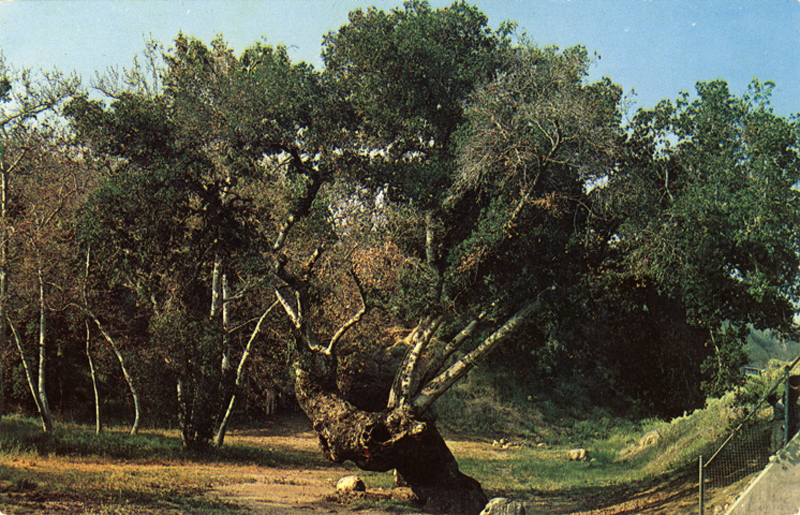
Perhaps you have been to Sutter's Fort where gold was picked out of a stream by James Marshall in 1848, an decisive event that remade our nation.  That discovery of gold in California is known by school children everywhere.  Well guess what.  Gold was first discovered in the Golden State in 1842.  In Newhall California.  Truth and legend say Francisco Lopez, a rider on the Spanish Rancho San Francisco (not to be confused with the city of SF) found gold flakes under an oak tree when he got off his horse to rest.  A mini-gold rush ensued that has been left out of the history books.  We local kids loved climbing in that oak tree--the Oak of the Golden Dream--which was polished smooth by generations of children who were fully aware of its significance.
 

Western America's first commercially successful oil well, No. 4, was drilled in 1876 in Pico Canyon, a few miles west of my house in a spot since called Mentryville.  The amount of oil brought out of the area was huge, and Well No. 4 was not closed down until 1990 after 114 years in business.  The Pioneer Oil Refinery, also a successful venture, was located a few miles across town.
 
"Pico Canyon Well No. 4" 
by Carleton E. Watkins (per Santa Clarita Valley history site http://www.scvhistory.com/scvhistory/ch1000.htm ) - Los Angeles Public Library http://catalog1.lapl.org/cgi-bin/cw_cgi?fullRecord+8510+968+46690+2+0.

 
 Pioneer Oil Refinery on Pine Street, about 2014
 
In the 1920s St. Francis Dam was built in San Francisquito Canyon, about 10 miles from my house, as part of a water project to slake the thirst of Los Angeles.  In 1928 the dam burst and millions of gallons of water swept 400 people to their deaths.  It was the largest man-made disaster in California history and ruined the career of the brilliant engineer, William Mulholland.  [photos are displayed on the links to previous posts]

 Tiburcio Vasquez (1835-1875) was a notorious rustler and bandit who terrorized and murdered storekeepers, ranchers and travelers all over the state.  He hid out in an area of convoluted rock formations, now called Vasquez Rocks, in the northeastern section of our valley.  It has long been a fascinating and favorite place for locals to hike and climb, and a movie set for Westerns and science-fiction films (John Wayne and Star Trek!).
Tiburcio Vasquez.png 
bad guy Tiburcio Vasquez

Beale Cut was a passage cleaved through a mountain on the southern end of Newhall in 1868 by Chinese laborers under the direction of General Edward Beale.  Pre Beale Cut, the rugged road from Los Angeles to points north (mainly San Francisco) was treacherous and usually impossible to ascend without the use of a windlass.  Beale's slice through the mountain made wagon and stagecoach traffic safe and do-able and opened up a new era of commerce and communication.  This route had been pioneered a hundred years before by Catholic friars and military men. After 1868 merchants and the Butterfield Stage made regular use of it.  Modern Scouts and schoolchildren, hikers and travelers have marveled at this 19th century engineering feat, and have thrilled at the marine fossils exposed in the vertical walls of the cut.  Hmmm, I wish I knew what happened to my fossil collection.
Beale Cut, also called (erroneously) Fremont Pass


 [Part 2 on Tuesday]


Sunday, November 8, 2015

An Unanticipated Privilege


My Dad served on the USS Missouri (BB63) for several years, beginning with the shakedown cruise out of the Brooklyn Navy Yard in mid-1944.  It was an important and exciting time in his life, and he spoke about it regularly during my growing-up years.

In 1984 we took our children up to Bremerton Washington early one morning to tour the Missouri.  It was not yet mothballed but moored at the harbor there (6 years later it was back in action for the Persian Gulf War).  This was my first time visiting the "Mo" and I was riveted by the spot where the kamikaze hit the ship, a story Dad had related again and again.  What a thrill to see the special plaque implanted in the deck, marking the very spot where the treaty to end the war with Japan was signed on September 2 1945.


Tourists were not allowed below the deck which saddened me.  Dad had described the complicated innards of the ship to me, which I hoped to see someday.  He remarked on the extremely tight quarters where sailors' bunks were shoehorned into every available nook and cranny.

Every June during Portland's Rose Festival, the city is visited by ships that tie up at the harbor wall while sailors come ashore to enjoy the festivities.  In 1990 the USS New Jersey (BB62) was among that year's visiting ships.  Because its tall tower could not fit under the city's bridges, she docked further north in Portland's industrial area.  The New Jersey is a sister ship to the Missouri, meaning that they're pretty much identical.  I took our children down to the dock for a tour.  We marveled at the massive guns that could lob shells 20 miles inland, the bulging boa-like ropes and chubby cables, and the gigantic anchor with chains even Samson himself couldn't burst.  I enjoyed the tour but wished the general public could explore below deck.


Before the New Jersey departed Portland, I made a second visit with only 4-year-old Teresa in tow, to spend more time viewing the details of the ship.  She became my golden ticket that day to get below deck.

As we approached the ramp leading up to the ship, exuberant Teresa tripped and fell, scraping her knee on the asphalt which drew blood.  To me it was a routine childhood injury which I cleaned up with mama spit and kleenex.  The teenage sailor monitoring the visitors saw the wound and declared it serious enough to call up a medic.  The medic determined the raw red knee was in need of immediate attention and bade us follow him onto the deck, and then through the hatch-way to the depths below.  I had just won the lottery!

Dad hadn't been kidding, it was extremely tight below deck.   There were no stairs, only ladders leading down down down into the dim bowels of the ship.  We descended several levels, me negotiating the ladders with one hand, and my other arm tight around Teresa's middle.  A few levels down there was barely room to turn around.  Mr. Medic instructed me to lay Teresa on a short, narrow shelf squeezed into a hallway, and then he worked with great care on her knee, finally wrapping it with a huge bandage held on by what seemed like yards and yards of white adhesive tape.

While he worked I took in the surroundings.  Bunkspaces were sandwiched in between floor-to-ceiling walls of electronics.  I imagined the ship burgeoning with the 2000+ crew she could carry.  What a bustling place these decks must have been during wartime action.  Every sailor was assigned a shift and a particular job on that shift.  Each was a piece of a vital puzzle.   In times of emergency, such as when the kamikaze hit, it was all hands on deck as fast as they could get there.  The privilege that was mine to see the netherworld of an American battleship did not escape me.  And I have Teresa's blood and tears to thank for it.

 The Missouri and the New Jersey docked together